June 24, 2026
More details ↓
The threatened purple pitcher plant is actively trapping and digesting insects at peak season, a carnivorous strategy enabled by early summer's abundant flying prey.
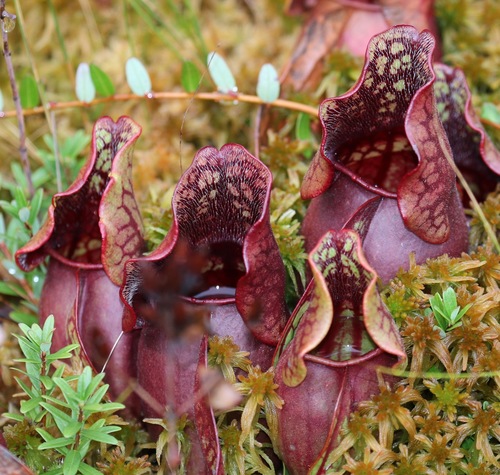
In the boggy margins near Weare, where sphagnum moss holds water like a saturated sponge and the ground gives slightly underfoot, the purple pitcher plant is open for business. Its hollow, fluid-filled leaves sit low among the moss, each one a deep reddish-green tube with a flared lip and a hood that does not close. This is not a snap trap. It works by waiting.
The purple pitcher plant grows in nitrogen-poor wetlands, bogs, and wet meadow edges across the northeastern United States, and this is one of its strongholds in New Hampshire, where it is listed as threatened. The plant cannot extract enough nitrogen from the waterlogged, acidic soil beneath it, so it supplements by digesting insects. Each pitcher leaf is partly filled with rainwater and the plant's own secretions. The lip of the pitcher is lined with downward-pointing hairs and coated with a waxy surface that insects cannot grip. A fly or a small beetle lands, loses its footing, and falls in. Once inside, the walls are too slick to climb. The insect drowns. Then the digestion begins, carried out by enzymes the plant secretes into the water, along with bacteria and a small community of invertebrates that live inside the pitcher and break down prey alongside the plant's own chemistry. The plant absorbs the resulting nitrogen directly through the walls of the leaf.
Early summer is when this strategy pays off most. Aquatic insects are emerging from nearby wetlands in numbers, and the long days mean more flight hours, more movement, more insects crossing the open ground of the bog. Crane flies, fungus gnats, small beetles, ants caught in the wrong place: these are the plant's most common catches. The pitcher does not distinguish. It attracts insects partly through color and partly through nectar glands around the lip, drawing in visitors that would otherwise have no reason to land on a leaf. If you look closely at a pitcher now, you may see the dark accumulation of past catches in the fluid below, or a small insect working its way toward the lip, not yet in trouble. The pitchers are at their most active this time of year. New leaves have fully formed and filled with fluid. The plant's single flower, which bloomed earlier in spring on a tall separate stalk, is finished, and the plant's energy has shifted entirely to trapping.
The bog habitat that supports pitcher plants also supports winterberry holly along its wetter edges and partridgeberry threading through the sphagnum in lower, shadier patches. Wood frogs bred here in spring and have moved into the surrounding forest by now. Common garter snakes move through the margins and will occasionally eat the small frogs. None of these species interact directly with the pitcher plant, but they share the same wet, acidic ground and the same flush of early summer insects. The eastern phoebe hunting from a low perch nearby takes the same crane flies the pitcher plant is catching, by a completely different method. The bog is not a single system with a single logic; it is several overlapping ones, each species extracting what it needs from the same brief abundance.
The pitcher plant cannot move toward its prey or pursue anything. What it does instead is make itself a reliable destination: the right color, the right smell, the right surface, in the right place, at the right time of year. Right now, in the longest days of summer, with insects moving in every direction across the wetland, the pitchers are full. Lean in close to one and you can hear, or almost hear, nothing at all — just the thin sound of wind across the bog and somewhere above you, the red-eyed vireo repeating its call from the canopy edge, patient and unhurried, the same phrase again and again.
