June 26, 2026
More details ↓
How Milk Frogs use their distinctive vocalizations to breed and establish territory during the warm, humid Yucatan summer when breeding conditions are optimal.
After dark in Mérida, when the heat of the day finally softens and the air thickens with humidity, the city's trees become something else entirely. The rains have arrived. Standing water collects in tree hollows, in bromeliads, in the gaps between roots. This is what the milk frog has been waiting for.
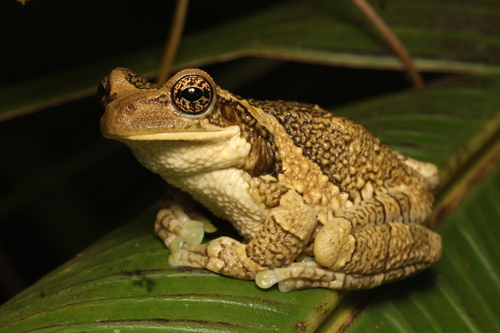
Milk frogs are large, pale, and built for the canopy. An adult is broad-headed and heavy-bodied, with adhesive toe pads that let it move across bark and leaf surfaces with ease. The skin is smooth and whitish, sometimes faintly mottled, and the eyes are large and gold-rimmed. During the dry months they are quiet and largely invisible, sheltering in tree cavities and waiting. But when the summer rains saturate the Yucatan Peninsula and water gathers in elevated pools, the frogs descend from their retreats and begin to call. The sound is loud and repetitive, a low resonant honk that carries well through dense vegetation. A calling male stations himself near a water-filled hollow and calls through the night, sometimes for hours. Other males respond. The result, on a good rainy night, is a layered chorus that bounces off walls and canopy alike.
The vocalization does two things at once. It draws females, who select mates based on call quality and persistence, and it signals other males about occupied space. Males that approach too closely trigger escalating call exchanges, sometimes followed by physical contact. Females move through this acoustic field and eventually approach a male at the water source. Eggs are laid directly onto the surface of the water pooled in the hollow, and the male fertilizes them there. The hollow matters: it protects the eggs from the kind of predation that ground-level clutches face, and the enclosed space keeps humidity high around the developing embryos. Tadpoles hatch and develop in the same water column, feeding on algae and organic debris that accumulates in the hollow. In a tree cavity with enough volume and shade, a clutch can develop through to metamorphosis in a few weeks.
The milk frog's reliance on arboreal water means it is sensitive to the availability of large, mature trees. Old-growth trees develop the deep cavities and structural irregularities that hold standing water; younger, smoother trees rarely do. In and around Mérida, that means the frog is concentrated in older parks, established neighborhoods with large shade trees, and patches of remnant forest. It shares some of this space with the invasive greenhouse frog, a small direct-developing species that needs no standing water at all and breeds in moist soil and leaf litter. The two frogs occupy different microhabitats and don't compete directly, but the greenhouse frog's presence is a measure of how modified the surrounding landscape is. Where greenhouse frogs are common, the original structure of the habitat has changed.
The ferruginous pygmy-owl hunts at dusk and dawn in the same trees where milk frogs call at night, and a large frog on an exposed branch is within range of what that owl will take. The northern potoo, which roosts motionless against bark during the day, is active in the same hours as the frogs. Whether potoos take milk frogs directly isn't certain, but they occupy the same nocturnal canopy and hunt by sight in low light. The gray fox moves through the understory below and would take a frog that descended to the ground.
The milk frog's skin produces a thick, whitish secretion when the animal is stressed, which is where the common name comes from. The secretion is irritating to mucous membranes and likely discourages some predators, though it doesn't deter all of them. It's not venom in the strict sense; it's more of a deterrent, something a predator learns to avoid after an unpleasant encounter.
If you are outside tonight, or near an open window, listen past the ambient noise for something low and repetitive coming from the trees. Not an insect. Not a bird. A deliberate, carrying call from something sitting still in the dark. The rain will have brought them out. The sound, if it reaches you, is coming from a hollow somewhere above.
