June 25, 2026
More details ↓
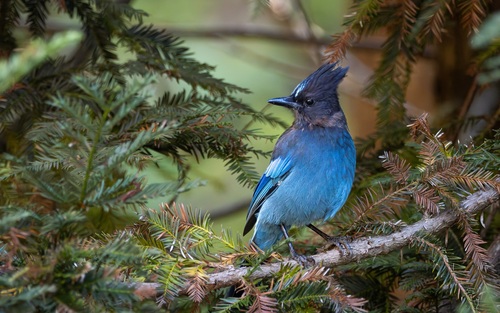
As Indian plum trees fruit in early summer, Steller's jays actively consume the ripening drupes, a keystone food source during peak nesting season when protein demands are highest.
The Steller's jays are loud this morning in San Juan County. You can hear them before you see them, a hard rasping call from somewhere in the understory, and when you find one, it is usually in an Indian plum, working the branches with its bill. The Indian plum has been fruiting for a few weeks now, and the drupes have moved from green to yellow to a dark, waxy blue-black. The jays know exactly when that shift happens.
Indian plum is one of the earliest shrubs to do anything in this forest. It leafs out in late winter, flowers before almost anything else, and by early summer it carries ripe fruit while the bigleaf maples and vine maples around it are still only producing leaves. That early timing matters here. The drupes are small, about the size of a blueberry, and they contain a hard pit surrounded by thin flesh. They are mildly bitter, not the kind of fruit that appeals to every bird, but Steller's jays take them readily. A jay will land on a fruiting branch, grip a drupe in its bill, and swallow it whole. The pit passes through intact. This is how Indian plum moves through the forest, carried by birds and deposited wherever the jay travels next.
For the jays, early summer is the most demanding stretch of the year. They are nesting now, and the nestlings require protein, which means the adults are hunting insects steadily, catching beetles and caterpillars and anything else they can find in the canopy. But the adults also need to sustain themselves through long foraging days, and the Indian plum drupes give them a reliable, calorie-dense food source that requires very little effort to find. The shrubs are large and heavily fruited right now, and a jay can harvest a significant amount in a short time. Watch one work through a single branch: it moves methodically, taking drupes in sequence, pausing occasionally to scan, then moving on. The oceanspray nearby is just opening its flowers, drawing insects, and the jay will sometimes drop from the Indian plum to snap something out of the air before returning. The two food sources, fruit and insects, are available within a few meters of each other at the same time, and the jays use both.
Steller's jays are also known to cache food, pressing items into bark crevices or burying them under duff. Whether they cache Indian plum drupes the way they cache acorns is less clear, but their habit of moving fruit away from the parent shrub is ecologically significant regardless. Indian plum tends to grow in the shrubby edges of Douglas fir and bigleaf maple forest, in the gaps and margins where light reaches the ground. Jays move between those margins and the denser interior, and seeds deposited in either place have a chance to germinate. Over time this matters for how the shrub distributes itself across the landscape.
The Steller's jay is not a bird that sits quietly. Its calls carry through the forest, and it frequently mimics the calls of red-tailed hawks, a behavior that has been observed to flush other birds from feeding areas. Whether that is the intent is hard to say, but the effect is real. This is a bird that is paying attention to everything around it, and right now what it is paying attention to is the Indian plum. If you are near any shrubby forest edge in the islands today, look for the dark blue crest moving through the outer branches of a fruiting shrub, and listen for that rasping call between the quieter sounds of the understory.
