June 24, 2026
More details ↓
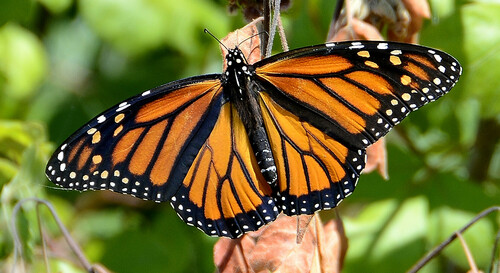
As milkweed plants fruit in early June, monarch butterflies arrive to lay eggs on the leaves that will feed their caterpillars through the summer.
Along the weedy margins of Brooklyn's open lots and park edges, the common milkweed is in full leaf now. The broad, paired leaves are a deep matte green, soft on the underside, and the plants stand knee-high or taller in the places where the soil has been disturbed enough to let them take hold. If you find a patch, look at the undersides of the leaves. You may already see what is coming.
Monarchs are moving through the region in early summer, and the females are laying. Each egg is a single pale dot, smaller than a pencil tip, pressed to the underside of a milkweed leaf with a small amount of adhesive. A female may lay several hundred eggs over the course of a summer, but she places them one at a time, often one per plant, spreading the risk. When the egg hatches, in three to five days, the larva eats its own eggshell first, then begins on the leaf itself. Common milkweed produces a sticky white latex that contains toxic compounds called cardenolides. Most insects cannot feed on it at all. The monarch caterpillar can, and it sequesters those compounds in its own tissues as it grows. By the time it pupates, it is unpalatable to most birds. The milkweed's defense becomes the caterpillar's defense. The relationship is not mutual in the strict sense — the milkweed gains nothing from the monarch — but the monarch is entirely dependent on plants in this one genus. Remove the milkweed, and there is no workaround.
In the same disturbed ground where milkweed grows, horseweed is coming up fast. Horseweed is a native plant, a tall and bristly annual in the aster family that colonizes roadsides, vacant lots, and any ground that has been scraped or compacted. It does not host monarchs. But later in summer, when it flowers, its small white heads will draw a range of small pollinators, and the monarchs that emerge from their chrysalises in August and September will need nectar sources for the long flight south. Horseweed and milkweed share the same ecological address: edges, gaps, disturbed ground, places that are not managed closely enough to be lawns but not wild enough to be forest. In a city like Brooklyn, that kind of ground is exactly where monarchs find what they need.
The red milkweed beetle is already on the plants. It is a striking insect, bright red with black spots, and it feeds on milkweed throughout its life cycle. Like the monarch caterpillar, it tolerates the latex and accumulates the toxins. The large milkweed bug does the same, piercing the seed pods to feed on the developing seeds. A single milkweed plant in early summer can be carrying the eggs or larvae of multiple specialist insects at once, each one using the plant's chemistry in its own way. The common eastern bumble bee works the flowers for nectar and pollen without any of that chemical tolerance — it simply avoids the latex by working the open florets where the sticky sap is not exposed.
The monarchs you see here are not the ones that overwintered in Mexico. That generation died in the spring. The butterflies laying eggs on Brooklyn milkweed now are their offspring, born somewhere to the south in April or May and continuing north. Their own offspring will be the ones that fly back to Mexico in the fall, navigating by the sun and by some sensitivity to the earth's magnetic field that researchers are still working to understand. The insect on the leaf in front of you has never made that journey and never will. It is here to reproduce, and the leaf it chooses determines whether its line continues.
The milkweed flowers are just opening on some plants, the pink-purple globe clusters tight and fragrant in the heat. Find a patch in sun and stand near it for a moment. The bumble bees are audible before they land.
