June 26, 2026
More details ↓
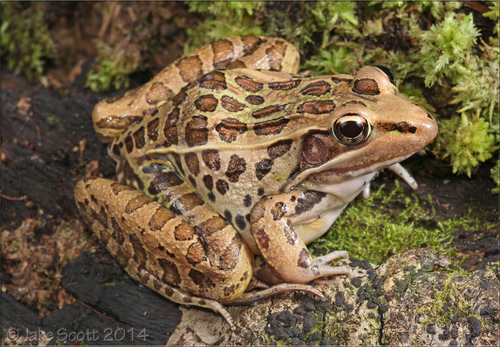
Southern Leopard Frogs are actively foraging and breeding in the wetlands around Lorton during peak summer—a critical window when these threatened amphibians are most visible and vulnerable.
At the edge of the wetland margins near Lorton, the water is warm and the vegetation is dense. Little bluestem and redosier dogwood press in close to the shoreline. The longest days of the year are here, and the southern leopard frog is making full use of them.
The southern leopard frog is a medium-sized frog, brown or green with irregular dark spots across its back and a pale stripe running along each side. It is a threatened species in this region, and the wetlands around Lorton represent some of its remaining habitat in northern Virginia. Right now, in peak summer, these frogs are most active and most visible. They sit at the water's edge or just inside it, facing outward, watching. Their eyes are set high on their heads, giving them a wide field of view above the waterline. When something moves within striking range, the frog lunges forward, opens its mouth, and the tongue does the work in a fraction of a second. The prey is pulled back before most observers register that anything happened.
What the frog is eating depends on what is available at the water's edge right now, and in summer that means a great deal. Aquatic insects emerge from the water in waves throughout the warm months. Dragonflies like the Needham's skimmer are hunting above the same water where their larvae developed. Midges, water striders, and various beetles move along the surface or hover just above it. The southern leopard frog is not selective. It takes what presents itself at the right size and distance. Beetles, flies, small moths, the occasional earthworm that wanders too close to the margin. Larger individuals will take small crayfish or even smaller frogs. The frog's hunting is tied entirely to its immediate surroundings, and those surroundings in summer are dense with invertebrate activity.
The frog is also prey. Great blue herons stand motionless in the shallows at Lake Accotink Park, and when a leopard frog moves, the heron strikes downward with its bill. Green herons use a slightly different approach, crouching low on overhanging branches and watching the water directly below. Common snapping turtles wait on the bottom in shallow areas. The leopard frog's spotted pattern helps it disappear against the dappled mix of mud, leaf litter, and water surface, but it is still taken regularly by these predators. Its primary defense is to jump, and it jumps at an angle, landing in the water and diving immediately. If you are near the water's edge and something small launches sideways from the bank in front of you, this is most likely what you are seeing.
The green treefrog, also threatened and present in these wetlands, occupies slightly different habitat. It climbs into vegetation above the water rather than sitting at the margin, and it is more nocturnal. Both species are sensitive to water quality and to the loss of wetland edge habitat, which is why their status in this region is being tracked. The water here measures near neutral pH and runs warm through the summer months, conditions that support the invertebrate communities these frogs depend on. But wetland edges are also exactly where invasive plants establish most readily. Persian silk tree, an invasive species, grows in disturbed areas near water throughout this region. Where it shades out native shoreline vegetation, the structure that leopard frogs use for cover and hunting disappears.
The spotted lanternfly, an invasive insect now widespread in this area, does not directly affect leopard frogs, but its presence reflects the degree to which the surrounding landscape has changed. It feeds on a wide range of plants, including native species at the wetland margin, and its population here is substantial.
If you are near still or slow-moving water right now, watch the bank for a few minutes without moving. The southern leopard frog often sits in plain view, but it holds very still, and the eye tends to pass over it. Look for the pale lateral stripe and the spotted back just at the waterline. The water is warm enough now that you may see ripples where one has just jumped in.
