June 24, 2026
More details ↓
A secretive rail at the northern edge of its range settles into breeding season in early summer, its presence unusual enough to prompt documentation among local observers.
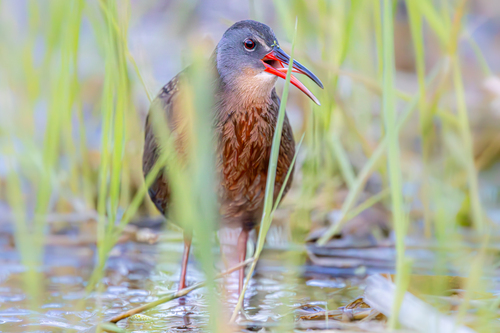
Listen for a sound like two stones knocked together, a rapid kik-kik-kik-kik that drops off at the end. That is the Virginia rail, calling from somewhere in the cattails and sedges at the wetland edge near Cambridge Village. You probably will not see it. That is characteristic of this bird. The rail moves through dense emergent vegetation with a laterally compressed body built for exactly this kind of travel, slipping between stems that would stop a larger bird entirely. The call is the main evidence of its presence, and right now, in early summer, it is calling often.
The Virginia rail is a small, rust-breasted wading bird, roughly the size of a robin but longer-legged and longer-billed, with a bill that curves slightly downward and works well for probing soft substrate. It is not a rare species across its range, but here in northern Vermont it sits near the upper edge of where it regularly breeds, and a nesting bird at this latitude is notable enough that local observers document it carefully. The wetland margins near Cambridge Village offer what it needs: shallow water with emergent vegetation, soft mud, and the aquatic insect emergence that peaks in early summer. The rail forages by wading slowly through the shallows, picking invertebrates from the water surface and probing into mud for worms, beetles, and small snails. It also takes aquatic insects, and the timing of its breeding season aligns with the period when those insects are most available.
Nesting happens low in the marsh, with the cup of woven plant material built just above the waterline, often anchored to standing stems of sedge or cattail. Star sedge grows in patches through the wet margins here, and northern blue flag is in bloom along the shallower edges, its purple flowers visible above the water. Both provide the structural cover the rail depends on. The female lays somewhere between six and thirteen eggs, and both parents incubate. The chicks are precocial, covered in black down at hatching, and able to leave the nest within days, though they stay close to the adults and are fed by them for several weeks. During this period, the adults are particularly vocal, and the grunting pig-like call the rail also produces, lower and more conversational than the kik call, is a way of keeping the family group in contact through vegetation that makes visual contact nearly impossible.
The wetland that supports the rail is also working for other species right now. American toads are finishing their breeding season in the shallower pools. Common garter snakes move through the wet margins, hunting the same invertebrates and small amphibians the rail takes. Barn swallows are hunting insects over open water nearby, taking the same emergence from the air that the rail takes from below. Common yellowthroats are singing from the shrubby edges, and song sparrows are nesting in the transition zone between wet and dry ground. The rail occupies a specific position in all this: the interior of the marsh, the densest and wettest part, which most other birds avoid. Tufted vetch, an invasive plant, has established along some of the drier margins here, and while it does not reach into the rail's core habitat, it competes with native plants in the transition zones that buffer the wetland from surrounding land.
If you stand at the edge of the marsh now, the light in early summer is long and the vegetation is at full height. The green false hellebore stands tall in the wet areas, its broad pleated leaves catching the afternoon light. The air over the water smells of wet soil and plant matter, the particular smell of a marsh in full production. Somewhere in the cattails, closer than you might expect, the rail is moving. The kik-kik-kik starts up again, and then stops.
