June 28, 2026
More details ↓
Cinnabar moths, with their distinctive red and black wings, are active hunters on flowering Greater Knapweed in early summer — a predator-plant relationship driven by the moth's caterpillar dependency on ragwort and the adult's nectar needs during peak breeding season.
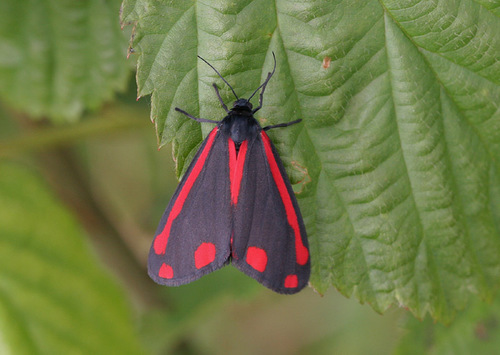
The grassland above Marle Hill is dense with flower heads right now. Greater knapweed stands a foot or more above the surrounding stems, its purple florets fully open, and if you walk slowly through the longest stretch of it you will almost certainly flush a cinnabar moth from the blooms. The wings are unmistakable: deep black with two scarlet spots on the forewing and scarlet hindwings beneath. It lifts a few feet, settles again, and carries on feeding.
The cinnabar is a day-flying moth, which puts it in the company of the marbled whites and meadow browns that are also working these flowers right now. But the cinnabar has a particular relationship with this landscape that goes beyond the nectar it takes from greater knapweed. The adults are breeding. The females are laying eggs in batches on the underside of ragwort leaves, lower in the sward, and the caterpillars that hatch from those eggs will feed almost exclusively on ragwort through the summer. The caterpillars are banded yellow and black, and they feed openly on the plant rather than concealing themselves. The coloring is a signal. Ragwort contains alkaloids that the caterpillars sequester in their own tissues, and those compounds persist into the adult moth. Birds learn quickly that the red and black pattern means something unpleasant, and they tend to leave cinnabar moths alone. The bright wings are not decoration; they are information.
Greater knapweed is doing something different for the adult moth than ragwort does for the caterpillar. The knapweed flower head is a dense cluster of individual florets, each producing nectar, and the architecture of the bloom keeps that nectar accessible to longer-tongued insects. The buff-tailed bumblebees working the same flowers are after the same resource, and so are the painted ladies that pass through in early summer. Field scabious nearby draws some of the same visitors. But the cinnabar tends to linger on knapweed specifically, and in grasslands where both plants are present together, the moth's breeding season and the knapweed's flowering period overlap almost exactly. The moth needs the energy from nectar to complete breeding; the knapweed gets visited by an effective pollinator. Neither organism is doing the other a favor in any deliberate sense, but the timing works out.
The grassland here also holds pyramidal orchid in bloom and common agrimony along the margins, both of which attract their own pollinators, and the scarlet tiger moth, another day-flier with warning coloration, is active in the same habitat. The Asian lady beetle, an invasive species now widespread across Britain, is present in the vegetation as well, and while it feeds mainly on aphids, it competes with native ladybird species for that resource. The grassland community here is not a simple one. There are interactions running in several directions at once, some of them well understood and some of them not.
What is straightforward is the cinnabar on the knapweed. The flower heads are at their best in early summer, and the moths are at peak activity in the same window. If you stand near a patch of greater knapweed for a few minutes, you will probably see one land. Watch how it moves across the florets, probing with its proboscis, wings held flat or slightly raised. The scarlet is very bright against the purple of the bloom. Somewhere lower in the vegetation, on a ragwort stem you may not even be looking at, there are probably eggs already laid, pale yellow, in a neat cluster on the underside of a leaf. The caterpillars will be feeding in a few weeks. Right now the adults are out in the open, in the longest days of the year, in full color against the flowers.
