June 24, 2026
More details ↓
The threatened Dusted Skipper butterfly depends entirely on Sundial Lupine for its caterpillars—a relationship playing out now as both species flower and breed in a narrowing window.
The open sandy areas near Concord hold a particular kind of stillness in early summer. The grasses stand thin, the soil between them pale and dry. Sundial lupine grows here in scattered patches, its spikes of blue-purple flowers just beginning to fade at the base while the upper florets still hold color. Look closely at those spikes and you may find something small moving: a dusted skipper, working the flowers or resting on a stem with wings half-open in the heat.
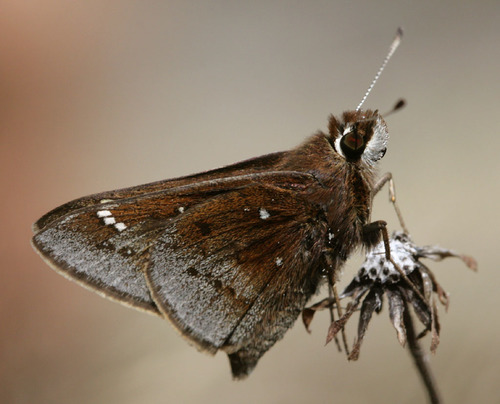
The dusted skipper is a small, dark butterfly, the upper wings a deep brown with a faint dusting of gray scales near the body. It is a threatened species in New Hampshire, and its situation here is tied directly to sundial lupine, which is itself threatened across much of its northeastern range. The caterpillars of the dusted skipper feed on lupine and almost nothing else. A female will locate a lupine plant, lay a single egg, and the larva that hatches will construct a shelter by rolling a leaf and fastening it with silk. It feeds, molts, and eventually overwinters in that shelter at the base of the plant, pupating in late spring. The adult that emerges in early summer has only a few weeks to find a mate and start the cycle again before the window closes.
This is the window right now. The lupine is in flower, which is when the adults are flying. That timing is not coincidental. The adult skippers do nectar on lupine, but they also use other open-area flowers nearby: spreading dogbane, common yarrow, annual fleabane. The frosted elfin, another threatened butterfly in this landscape, shares the same dependence on lupine for its caterpillars, and the two species can sometimes be found in the same patch. What limits both is the same thing: the lupine itself. Sundial lupine requires open, sunny, well-drained, sandy ground. It does not persist in shade or in dense grass. Across southern New Hampshire, that habitat has been compressed by development and by the natural succession of open land back into scrub and forest. What remains is patchy, and the populations of both butterflies are patchy to match.
The sandy openings here are also under pressure from invasive plants. Smooth brome and autumn olive have both established in this area. Smooth brome is an invasive grass that forms dense sod, shading out lupine seedlings and filling the open ground the plant needs. Autumn olive, an invasive shrub, advances the succession of open areas toward dense cover. Neither species kills lupine outright, but both narrow the ground it can hold. The dusted skipper does not adapt to a different host plant. If the lupine goes from a site, the skipper goes with it.
The grasshopper sparrow has been recorded in this area, and that tells you something about the structure of the habitat: open, grassy, with bare patches and low vegetation. It is the same structure that suits lupine. The two things are indicators of the same conditions, though they have nothing to do with each other directly. What they share is ground that has stayed open long enough for species with narrow requirements to establish.
If you are standing near a lupine patch right now, watch the flowers for a minute. The dusted skipper is not a flashy insect. It holds low, moves quickly between stems, and perches with wings folded when it rests. The undersides of the wings are patterned in soft brown and cream, which makes it nearly invisible against a dry stem. You are more likely to notice it moving than sitting still. The flower spikes are tall enough to catch whatever breeze is crossing the opening, and in the heat of midday the whole patch shimmers faintly. That is the moment the skippers are most active, when the air is warm and the lupine is still in bloom.
