June 25, 2026
More details ↓
Barn swallows in early summer are feeding on the peak emergence of aquatic insects — mayflies, caddisflies, and other dipterans rising from water — during their most demanding nesting season, when they must provision growing nestlings multiple times per hour.
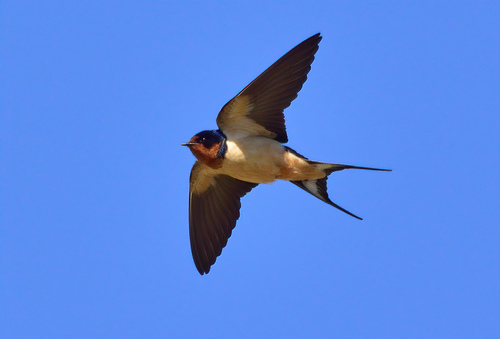
Out over the 64th Street Grassland, the barn swallows are working. Not perched, not resting — moving, continuously, in long arcing passes that drop low over the grass and wheel back up toward the tree line. Early summer is the most demanding period of the year for them, and the air here is full of what they need.
Barn swallows are aerial insectivores, which means they catch everything they eat on the wing. They do not hover or wait. They fly through concentrations of insects and take them one at a time, bill snapping shut mid-air, and then they continue. A pair with nestlings will make several hundred feeding trips per day. The nest — a half-cup of mud and grass, fixed to a beam or rafter in a barn or outbuilding — holds four or five chicks that are growing fast and need protein in volume. Both adults feed them, and both adults spend the longest days of the year doing almost nothing else.
What makes early summer the right moment for this is the insects. Aquatic insects are emerging from the standing water and slow streams near Geneva Township in numbers that peak right now. Mayflies crawl out of the water as winged adults after spending a year or more as aquatic larvae. Caddisflies do the same, rising from stream gravel and pond margins. Midges and other small flies emerge in masses from the surface, sometimes thick enough to be visible as a haze over the water at dusk. These are not random events. Each species has its own emergence window, triggered by water temperature and day length, and early summer stacks several of them at once. For the swallows, this is the richest stretch of the year.
Barn swallows are built for this kind of foraging. The tail is long and deeply forked, which gives them fine control at speed — they can redirect quickly when an insect changes course, and they can fly efficiently for hours without tiring. The bill is short and wide, which opens into a broad gape, better for intercepting insects in flight than for picking them off a surface. When you watch one hunting low over a field, the flight path looks irregular, but it is tracking real things: a midge column, a rising caddisfly, a cluster of gnats near a wet depression in the grass. The swallow adjusts its line to what the air holds.
The grassland itself matters here. Open ground with nearby water is the core of their habitat in this region. The 64th Street Grassland sits within a landscape that still has both. Bobolinks and savannah sparrows nest in the grass below, and killdeer move across the open patches at ground level, but the swallows occupy the airspace above all of it. They are not competing with those birds for food or space. They are using a different part of the same place.
The nestlings grow quickly. Within about three weeks of hatching, they are close to adult size and beginning to fledge. The parents' workload through that period is relentless: catch an insect, return to the nest, deliver it, go out again. In the early morning and again in the evening, when insects fly closer to the surface and the air is cooler and denser, the swallows tend to fly lower and faster. If you are out at those hours, the passes can come very close.
There is no real rest in this season for them. The chicks that survive to fledge will spend the rest of summer learning to hunt on their own, building the flight skills they will need before the whole population moves south in late summer. But that is weeks away. Right now, the adults are out, the insects are rising, and the air over the grassland is busy with both. Look up and watch one complete a pass — the long glide out, the quick bank, the return — and somewhere in that arc, it has eaten.
