June 24, 2026
More details ↓
As milkweed plants leaf out in early summer, red milkweed beetles emerge to feed and breed on their host plants, a relationship visible in the peak nesting season.
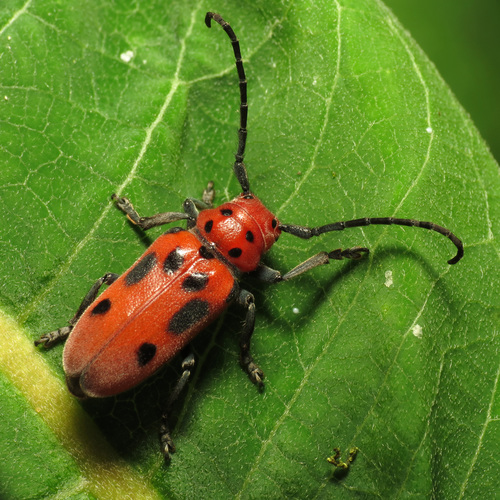
Along the edges of open ground near Watertown, the common milkweed is fully leafed out now. The plants stand knee-high to waist-high, their broad gray-green leaves thick with a waxy coating, and if you look closely at the stems and leaf surfaces, you may find a beetle the size of a grape seed, bright red with black spots, moving slowly across the plant. That is the red milkweed beetle, and it is exactly where it needs to be.
The red milkweed beetle spends its entire life on common milkweed. Not near it, not occasionally visiting. On it. Adults emerge in early summer just as the milkweed plants reach full leaf, and they begin feeding immediately, chewing through leaves and stems to reach the sap beneath. Milkweed sap is loaded with cardenolides, toxic compounds that would kill or sicken most insects. The red milkweed beetle has a specific mechanism for handling this: before chewing into a leaf, it cuts a groove across the midrib, which interrupts the flow of latex to the feeding site. The beetle then feeds in the dry zone it has made. This is not random gnawing. It is a precise sequence of behaviors that makes the plant's defense temporarily irrelevant.
The toxins the beetle ingests anyway, in smaller amounts, accumulate in its body. That red and black coloration is a signal to birds: this insect is not worth eating. Blue jays in the canopy above, American robins foraging in the understory, they have learned this, or learn it quickly if they haven't. The beetle moves slowly and without apparent concern, which makes sense given what it carries. Monarchs, which are present here in early summer and use the same milkweed plants as their sole larval food source, rely on the same chemistry for the same reason. Two completely unrelated insects, a beetle and a butterfly, have each found a way to use the plant's toxicity as protection, and both advertise it with orange or red against black.
In early summer, red milkweed beetles are also mating on the plants. Pairs are often visible, the male riding the female for extended periods, which is common in beetles and serves to guard the female against competing males. After mating, the female chews a notch into the base of the milkweed stem near the soil, deposits her eggs there, and the larvae burrow down into the root system. The larvae feed underground on the roots through summer and into fall, overwintering below the frost line and completing their development the following spring. The adult beetle that emerges has never been aboveground before. It finds milkweed by detecting volatile compounds the plant releases, and the cycle begins again.
Common milkweed is doing significant ecological work in this landscape right now. Its flowers, which open in dense globe-shaped clusters, are among the most productive nectar sources of early summer. The invasive western honey bee visits them heavily, as do native bumblebees, various wasps, and the great spangled fritillary. The flowers have a complex structure that traps insect legs briefly in small slits, coating them with paired pollen masses called pollinia when they pull free. A single milkweed plant can provision a remarkable number of insects during its bloom period, which begins just after the leafing-out stage the plants are in now.
The beetle does not pollinate milkweed in any significant way. Its relationship with the plant is entirely extractive: it takes sap, it takes root tissue, it uses the plant's chemistry for its own defense. The milkweed tolerates this, more or less. Plants that are heavily chewed or have their roots damaged by larvae will sometimes die back, but milkweed spreads by rhizome and tends to persist even when individual stems are lost. The relationship between plant and beetle has no obvious mutual benefit. The beetle depends completely on the milkweed; the milkweed gets nothing in return.
The milkweed leaves near you, if there are any, carry the slight rubbery smell of cut latex even when undamaged. Run a thumb along the underside of a leaf and you can feel the texture of the surface hairs. The beetles, when you find them, are unhurried. The longest days of the year are here, and the plants are at full size, and there is no reason to rush.
