June 25, 2026
More details ↓
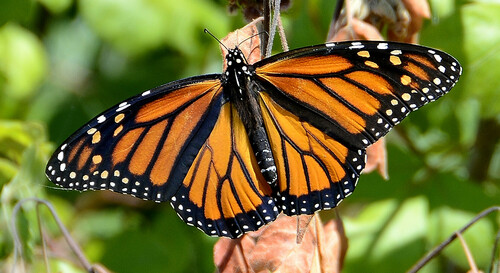
Monarch butterflies are arriving and laying eggs on common milkweed during the nesting peak, anchoring their entire life cycle to a single native plant.
Common milkweed is in full leaf near Brigham right now, the broad flat leaves catching the long light of early summer. The plants stand waist-high in open areas, clusters of them in disturbed ground along roadsides and field edges, their pink-purple flower heads just beginning to form. This is the moment monarchs have been moving toward since they left their overwintering sites in central Mexico.
Monarchs are arriving here as part of the second generation working northward through the season. The adults that reach southern Wisconsin in early summer are not the same individuals that left Mexico. That first generation hatched in Texas and the Gulf states, developed, and pushed the range northward. The butterflies reaching Brigham now are the offspring of that generation, and they are here specifically because common milkweed is here. The female lands on a leaf, drums the surface briefly with her forelegs, and detects the chemical signature of the plant. If it registers correctly, she curves her abdomen and deposits a single egg on the underside of the leaf, pale green and ridged, about the size of a pinhead. She will lay hundreds of eggs over her lifetime, but never in clusters. One egg per leaf, often one per plant, spread across a patch.
The reason for this is the plant itself. Common milkweed produces cardenolides, compounds that disrupt the heart function of most animals that eat it. The monarch caterpillar has proteins in its cell membranes that are shaped differently from those of other insects, so the toxin passes through without binding. The caterpillar sequesters the cardenolides in its own tissue, and that chemical defense carries through metamorphosis into the adult butterfly. A blue jay that catches and eats a monarch will vomit within minutes. After one or two such experiences, most jays avoid the orange-and-black pattern entirely. The egg on the underside of a milkweed leaf is already committed to this system before it hatches.
The milkweed supports more than monarchs. Red milkweed beetles are present on these plants right now, their bright red wing covers making them easy to spot against the green leaves. They feed on the plant and sequester the same cardenolides by the same mechanism, a separate lineage that arrived at the same solution. Two-spotted bumble bees work the flower heads when they open, collecting both pollen and nectar. The flowers have a complex structure that traps visiting insects momentarily, coating their legs with pollen masses called pollinia before releasing them. The bees carry these pollinia to the next plant. Common milkweed depends almost entirely on bees of sufficient size to trigger that mechanism, and bumble bees are among the most reliable visitors.
The monarch egg will hatch in three to five days, depending on temperature. The caterpillar that emerges feeds only on milkweed, moving through five growth stages over roughly two weeks. It pupates on or near the plant, forming the green chrysalis with its row of gold dots, and emerges as an adult after about ten days. The adults from this generation will feed on nectar from whatever flowers are available, including wild quinine and the invasive oxeye daisy and red clover that are blooming across open ground near Brigham right now. They will mate, lay eggs, and die before the season turns. It is their offspring, the generation that hatches in late summer, that will make the migration south.
If you're near any open ground or a field edge, look for the milkweed. The leaves are broad, slightly waxy, and if you pinch one it bleeds white latex immediately. Turn a few leaves over and look at the undersides near the midrib. The eggs are small enough to miss if you're moving, but they are there. Somewhere nearby, a monarch is working the patch, pausing on each plant long enough to assess it, then moving on or stopping to lay. The wings open and close slowly in the heat.
