June 25, 2026
More details ↓
Double-crested Cormorants exploit the early-summer peak of aquatic insect emergence, diving to feed on fish that congregate to consume massive hatches of mayflies, caddisflies, and other aquatic insects.
At Decker Lake in early summer, the water surface breaks in small rings — fish rising to take insects that have just hatched from the bottom. This is one of the more productive moments in the aquatic calendar here, when mayflies and caddisflies complete their underwater phase and emerge into the air by the thousands. The fish know it. And above the fish, so do the double-crested cormorants.
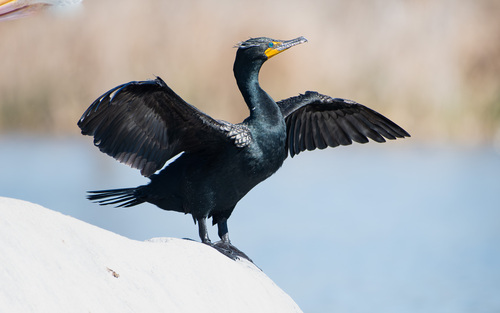
Cormorants are not subtle hunters. A bird sitting on a piling or a low branch near the water's edge will drop in with little ceremony, disappear beneath the surface, and begin working. They dive with their feet, not their wings, kicking hard to pursue fish in open water or along the bottom. Their feathers are only partially waterproof, which sounds like a disadvantage but allows them to dive with less buoyancy to fight against. The tradeoff is that they must dry out afterward, which is why you see them standing with wings spread wide, sometimes for long minutes, in what looks like deliberate stillness. They are not posturing. They are drying. The double-crested cormorant is listed as threatened in Utah, and the seven birds recorded around this area represent a small but real presence at a productive lake.
What draws them here in early summer is a cascade of events that begins underwater. Aquatic insects — mayflies, caddisflies, midges — spend most of their lives as larvae on the lake bottom or clinging to submerged vegetation and debris. When water temperatures rise and day length peaks, they transform and rise. The emergence can be dense enough to film the water's surface with wings. Fish, particularly the small cyprinids and silversides that make up the forage base in lakes like Decker, move into the shallows and toward the surface to feed on the emerging insects. They concentrate. And concentrated fish are exactly what a cormorant is looking for. The bird is not responding to the insect hatch directly; it is responding to what the hatch does to the fish. The insects reorganize the water column, and the cormorant follows that reorganization down.
Other birds are working the same emergence from different angles. Forster's terns hover and plunge-dive at the surface, taking insects and small fish from the top inch of water. California gulls pick off anything that floats or flutters near the surface. Clark's grebes dive in the open water, their long necks adapted for a quick stabbing strike at fish rather than a sustained underwater chase. The flame skimmer dragonflies patrolling the margins are themselves former aquatic insects, now hunting the ones that are still emerging. Each of these species is pulling from the same brief abundance, but at different depths and by different methods, so they do not simply compete with one another. The cormorant, working deepest, has the water column largely to itself.
The spotted sandpiper picking its way along the bank, bobbing as it goes, is after the same insects at the water's edge — the ones that crawl out onto wet mud before their wings dry and harden. American avocets sweep the shallows with their upturned bills. White-faced ibis probe the soft margins. The aquatic insect emergence is not a single event; it is a resource that radiates outward from the water in stages, and the birds present at Decker Lake in early summer are arranged along those stages, from the mud at the edge to the open water ten feet down.
If you are near the water now, watch for a cormorant sitting low on a post or a rock, wings held open. The feathers will look dark and slightly ruffled rather than smooth. That bird has been diving recently, and it will go back in. The rings the fish leave when they rise are small and quick, easy to miss if you are not looking for them. They appear and close in a second or two, a few inches across, and then the surface is flat again.
