June 24, 2026
More details ↓
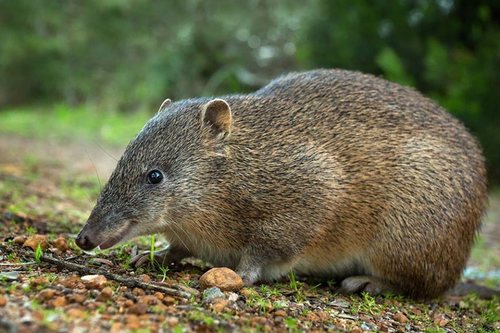
A threatened marsupial emerges during the longest days to hunt invertebrates in regenerating Perth bushland, exploiting the seasonal abundance of insects.
The light is still warm at eight in the evening in Perth's bushland in summer. The longest days push sunset late, and the heat that built through the afternoon sits in the leaf litter, rising off the sandy soil in waves you can feel at ankle height. This is when the quenda comes out.
The quenda is a southern brown bandicoot, a small marsupial about the size of a rabbit, with a pointed snout, coarse brown fur, and back feet built for digging. It is threatened across its range, and the Perth bushland is one of the places where it still holds on. It is not a grazer or a browser. It is a digger and a hunter. The quenda moves through the understorey with its nose pressed close to the ground, reading the soil. When it detects something beneath the surface, it drives its snout down and excavates a small conical hole, a few centimetres across, with a speed that looks almost mechanical. Then it moves on. In good habitat, the ground behind a foraging quenda is pocked with these small diggings, each one the record of a successful find.
What it finds is invertebrates. Beetle larvae, earthworms, fungi, the occasional spider or centipede. In summer, the soil community is active. Insects are breeding, larvae are developing underground, and the warm nights push invertebrate movement closer to the surface. The quenda is well suited to exploit this. Its long claws break compacted soil easily, and its snout is sensitive enough to locate prey that is not moving and not visible. It works by smell and by feel. The late dusk of summer suits it: enough light to navigate, enough warmth to keep the invertebrates accessible, and a window of activity before the larger predators that hunt by sound and movement are fully active.
The quenda's digging does more than feed it. Each small excavation turns over the soil, mixing organic material downward and exposing the mineral layer beneath. In the jarrah and banksia woodland around Perth, this kind of low-level disturbance is part of how the soil stays aerated and how fungal spores get redistributed. The quenda feeds on hypogeal fungi, the kind that fruit underground, and carries spores through the landscape in its gut. Those spores are later deposited elsewhere, sometimes far from where they were consumed. The acorn banksia and firewood banksia that grow here depend on mycorrhizal fungi in the soil to take up phosphorus from the nutrient-poor sand. The quenda, moving through the understorey at dusk, is part of that system. Its foraging and the health of the banksia canopy are connected through the soil.
The laughing kookaburra, an invasive species introduced to Western Australia from the east, is active at this hour too, and it takes small vertebrates, lizards, and the occasional young marsupial. The presence of kookaburras in Perth bushland is one of several pressures the quenda contends with, alongside fox predation and habitat fragmentation. But at dusk, in intact scrub with dense understorey, the quenda moves in cover. It is not often seen. If you are near low banksia scrub or regenerating bush right now, look for the small conical diggings in exposed sandy soil. They are easier to find than the animal that made them.
The ghost fungus grows on dead wood in this bushland, and in the long summer evenings it is faintly visible after dark, a pale luminescence on the bark of old logs. The quenda passes these without interest. It is looking for something that moves, or something that smells like it recently did. The sky above the canopy is still blue at the horizon. The air smells of warm eucalyptus resin and dry sand. Somewhere in the understorey, a small animal is pushing its nose into the ground.
