June 24, 2026
More details ↓
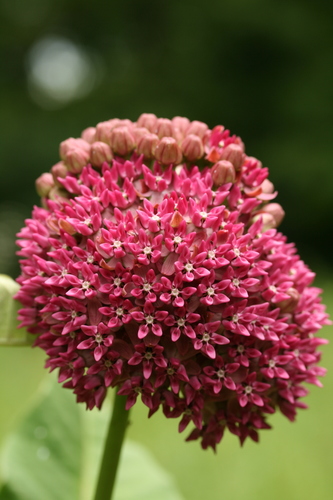
As purple milkweed flowers and sets fruit in early summer, red milkweed beetles actively feed and lay eggs on this threatened native plant, creating a visible window into a specialized host-plant relationship.
Along the wet meadow edges near Morristown, the purple milkweed is in flower. The blooms come in tight, rounded clusters, deep rose-pink, held up on stems that reach waist height or a little above. This is one of the less common milkweeds in the region — it favors moist, partially shaded ground, the kind of transitional habitat where a woodland gives way to open air — and right now it is carrying more than just flowers. Look closely at the stems and you will find the red milkweed beetle.
The beetle is hard to miss once you know to look. It is about the size of a large raisin, bright red-orange with black spots, and it moves slowly and deliberately along the milkweed stem. That color is not incidental. Milkweed plants, including purple milkweed, produce cardenolides: toxic compounds that accumulate in any insect that feeds on the plant. The beetle feeds on milkweed almost exclusively, sequestering those toxins in its own body. The red and black pattern advertises that fact to potential predators. Birds that have learned the lesson leave it alone. The beetle's antennae are worth noting too: they are divided so that each eye is split into an upper and lower half, one pair above the antennae and one below, giving it nearly full-circle vision from a stationary position on the stem.
Purple milkweed is a threatened plant in New Jersey, present in scattered patches but not reliably common anywhere. The red milkweed beetle is tied to it and to other milkweeds almost completely. The female chews a groove around the base of a milkweed stem before she lays her eggs there. That groove interrupts the flow of latex — the sticky white sap that milkweed produces as a defense against feeding insects — so that when the eggs hatch and the larvae chew down into the stem, they are not fouled by it. The larvae then tunnel into the root, feeding through the rest of summer and into fall, overwintering underground, and emerging as adults the following year. The adult beetles you see feeding on stems and flowers now are the result of last year's eggs. They are feeding on leaf tissue, on flower parts, and probably on the latex itself in small amounts, moving slowly enough that you can watch them work.
Common milkweed grows nearby in sunnier spots, and poke milkweed appears in shadier ground, and the red milkweed beetle uses both. But purple milkweed's early summer flowering puts it in synchrony with peak beetle activity right now, and the plant's relative scarcity in this landscape makes each patch matter more. Brown-belted bumble bees are also working these flowers — milkweed blooms require a strong insect to trip the pollen mechanism, and bumble bees are effective at it. The beetle feeds on the flowers too, but it is not an efficient pollinator; it takes without reliably delivering. That is a common dynamic on milkweed, where the plant hosts a community of insects with very different relationships to its reproductive success.
If you are near a patch of milkweed right now, the beetles are almost certainly there. They do not startle easily. You can get close enough to see the divided eyes, the deliberate movement of the mouthparts, the way the insect pauses on a stem and seems to assess its position before moving again. The flowers smell faintly sweet, a smell that carries a few feet in still air. That smell is part of how the plant recruits pollinators, and it is probably part of how the beetle locates the plant from a distance. Stand near it for a moment and you may catch it too.
