June 24, 2026
More details ↓
Cownose rays move through coastal waters in aggregations during summer, using their distinctive snouts to excavate mollusks and crustaceans from the seafloor—a visible ecological relationship between a vulnerable predator and its benthic prey.
Off the coast near Delray Beach, the summer water is warm enough to see through in the shallows, and if you watch the surface from a pier or a seawall, you may catch a set of wingtips cutting just below it, moving steadily through the green water. That is a cownose ray, and where there is one, there are usually more.
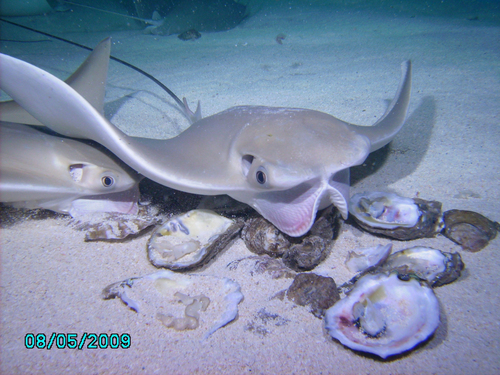
Cownose rays travel in aggregations during summer, sometimes dozens together, sometimes hundreds, moving along the coast in loose formations just above the seafloor. They are large animals, with wingspans reaching three and a half feet, and their movement is unhurried. The name comes from the distinctive shape of the snout, which is divided into two rounded lobes, giving the front of the head a blunt, bilobed look. That snout is not just a shape. It is a digging tool. When a ray finds a promising patch of bottom, it tilts forward and fans its pectoral fins rapidly, flushing water into the sediment and blowing a small crater into the sand or mud. What gets exposed is what the ray came for: hardshell clams, oysters, and other buried mollusks. The ray presses its snout into the excavation, locates the prey, and crushes it between flat, interlocking dental plates that are built for exactly this. Hardshell clams, which can close their shells against most threats, are simply ground down.
Hardshell clams are common in the sandy and muddy shallows of South Florida's coastal lagoons and nearshore waters. A single clam filters several liters of water per hour, pulling out phytoplankton and suspended particles. Dense clam beds are, among other things, water-cleaning infrastructure. The cownose ray is their primary predator in these shallows, and the relationship between them is direct and physical: one organism has spent its life buried in sediment, filtering the water column, and the other has a specialized face for finding and crushing it. When a group of rays moves through a clam flat, the disturbance is visible. The bottom clouds with suspended sediment, and the craters they leave behind are real pits in the seafloor, each a few inches across. Other animals follow. Yellow-crowned night herons, which are present along this coast right now and are themselves recovering from population pressure, will wade into the disturbed water to pick up invertebrates that the rays have turned up but not eaten. What the ray excavates, the heron finishes.
Cownose rays are listed as vulnerable. They are slow to reproduce, typically producing one pup per year, which means populations take a long time to recover from fishing pressure. They have historically been targeted in large numbers, partly because of their documented impact on shellfish beds, particularly farmed oysters. The ecological picture is more complicated than that framing suggests. Rays have been moving through these waters long before commercial shellfish operations existed here, and their excavation of the seafloor, while locally destructive to clam beds, also turns over sediment in ways that affect nutrient cycling and the composition of benthic communities. Removing large numbers of rays from a system does not straightforwardly protect shellfish; it changes the system in ways that are harder to predict.
Summer is when this is most visible from shore. The water is warm, the rays are active, and the aggregations move close to the beach. If you are near the water's edge, look for a dark triangular shape just under the surface, tilted slightly, moving with a slow beat of the wings. The wingtip may break the surface for a moment, then disappear. Farther out, you might see the disturbance in the water where a group has settled to feed, a soft clouding of the bottom that drifts and disperses in the current.
