June 25, 2026
More details ↓
As eastern redbud fruits ripen in late spring, cedar waxwings move through the canopy in small flocks to harvest them—a seasonal feeding relationship now visible at peak fruiting.
The eastern redbuds along the forest edge at Blue Rock are carrying fruit now. The flowers are long gone, replaced by flat, papery seed pods that hang in clusters from the branches like rows of green tags. The leaves have filled in fully, and the tree looks ordinary from a distance, the kind of understory tree you walk past without stopping. But the pods are there, and the cedar waxwings have found them.
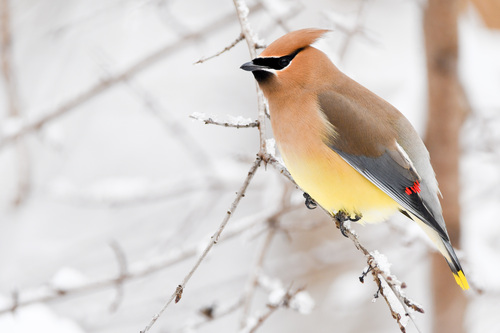
Cedar waxwings move through the canopy in small, loose flocks. They are compact birds, smooth-plumaged in warm brown and gray, with a black mask across the face and a yellow band at the tip of the tail. The red waxy spots on their secondary wing feathers, the ones that give them their name, are visible only up close. They tend to arrive without much announcement, a high thin seee from somewhere in the canopy, and then suddenly several birds are working the same branch. They pick through the redbud pods efficiently, taking seeds and pulp and moving on. If you watch long enough you may see one pass a food item to the bird beside it. This happens regularly in flocks, a behavior that appears connected to pair bonding, though it is common outside of courtship as well.
The eastern redbud is a native understory tree, common on the slopes and hollow edges of this part of Ohio. It blooms early, before the leaves emerge, covering bare branches in pink-purple flowers that are visited by native bees pulling nectar in late winter cold. By summer the flowers are gone and the pods have formed, each one containing several hard, oval seeds. The pods persist on the tree for months, drying and darkening as the season advances. For the waxwings, this is a reliable food source that bridges the gap between the soft fruit they prefer, wild cherries, serviceberries, mulberries, and the berry crops that will come later in summer and fall. Waxwings are among the most fruit-dependent birds in North America. They time their movements and breeding around fruit availability, nesting later in summer than most songbirds so their chicks can be fed on ripe fruit rather than insects.
The redbud offers something else, too. Because the pods hang exposed on the outer branches, they are accessible to birds that prefer to forage in the open rather than deep in the foliage. The wood thrush foraging on the forest floor below, or the red-eyed vireo working the interior of the canopy for insects, are not competing for the same resource. The waxwings occupy a foraging zone that is largely their own. Where Morrow's honeysuckle, an invasive shrub present in this area, produces berries later in the season, waxwings will take those too, which makes them occasional agents of its spread. But at this moment, in high summer, it is the redbud pods they are after.
The flock does not stay long in any one tree. They move, they call, they settle briefly and move again. If you are standing near a redbud right now, look at the outer canopy, where the pods are most exposed. The birds tend to perch upright at the branch tips, reaching sideways to pull at the pods. Listen for the call, a very high, thin whistle, almost at the edge of hearing, repeated at irregular intervals. It carries well through summer air. The light is long today, the longest days of the year, and the canopy at Blue Rock is fully closed and dark from below. Somewhere in it, a flock of waxwings is moving from tree to tree, and the thin sound of their calls comes down through the leaves.
