
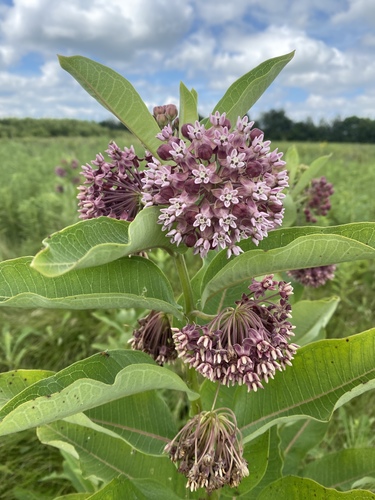
Milkweed blooms as monarchs arrive
June 11, 2026
0:000:00
More details ↓
The emergence of common milkweed flowers in early summer coincides with the arrival of monarch butterflies seeking both nectar and a host plant for their caterpillars—a critical moment in their reproductive cycle.
Transcript
The air above the meadow edges near South Portland carries the sweet weight of early summer. Common milkweed stands shoulder-high now, their broad leaves catching the longest light of the year. Pink flower clusters crown each stem, dense with nectar and thick with scent. The timing is no accident. These blooms open just as the first monarch butterflies return from their southern journey, orange wings flickering through the warming air.
A monarch lands on a milkweed flower head, legs gripping the tiny individual flowers that make up each rounded cluster. The butterfly probes deep with its coiled tongue, drawing nectar that will fuel egg-laying in the days ahead. But this plant offers more than food. The monarch tests the milkweed leaves with chemical sensors on its feet, reading the plant's defensive compounds. These same toxins that protect the milkweed from most herbivores will become the monarch caterpillar's shield, absorbed and concentrated in its tissues to make it unpalatable to birds and other predators.
The female monarch curls her abdomen beneath a milkweed leaf and deposits a single cream-colored egg. She moves to another plant, then another, spacing her eggs across the meadow. Each caterpillar will need an entire milkweed plant to complete its growth, consuming leaves that would kill most other insects. The milkweed tolerates this specialized herbivory because monarchs are efficient pollinators, their large bodies picking up pollen as they feed and carrying it between plants. The relationship runs deeper than simple exchange. Monarch caterpillars that feed on milkweed with higher concentrations of defensive compounds become more toxic themselves, better protected as adults. The plant's chemical arsenal becomes the butterfly's inheritance.
Other insects work the milkweed flowers alongside the monarchs. Milkweed beetles with their red and black warning colors feed on stems and leaves, also adapted to the plant's toxins. Bees and flies probe for nectar, their smaller bodies requiring multiple visits to gather what a monarch collects in one feeding. The invasive black locust trees blooming nearby offer abundant nectar too, but they cannot provide what the monarch needs most: a place to raise young that will survive.
The milkweed's flowering peaks now, in these longest days, when monarch numbers are still climbing toward their summer height. Each plant may produce several thousand seeds by autumn, carried on white silk parachutes to new ground. But first comes this moment of abundance, pink flowers heavy with nectar under the extended light of early summer. The sweet scent drifts across the meadow, calling to orange wings that have traveled a thousand miles to find it.