June 27, 2026
More details ↓
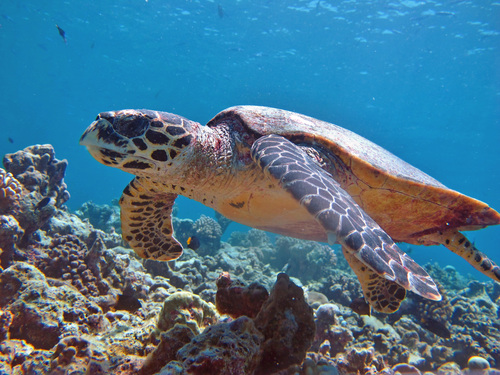
Hawksbill sea turtles (Eretmochelys imbricata) arrive at the beach during summer nesting season to dig their chambers and lay eggs in the sand.
The beach near Nandayure goes quiet as the light drops. The dry season birds have pulled back into the forest edge, and the surf takes over the soundscape. This is the hour the hawksbill turtles come ashore.
Hawksbills are smaller than the leatherbacks or greens that share these Pacific waters. An adult female weighs around eighty kilograms, and her shell is narrow and tapered at the front, with overlapping scutes that give it a ridged, shingled look. Her beak is pointed and slightly hooked, shaped for pulling sponges off coral heads. She spends most of her life at sea, feeding in the reef systems offshore, but summer draws her back to this stretch of sand. She navigates by the earth's magnetic field, detecting both the intensity and inclination of the field lines, and she returns to the same beach where she hatched. Not the general region. This beach. Researchers have documented females nesting within meters of where they emerged decades earlier.
She comes ashore after dark. She moves across the wet sand slowly, pulling herself with her front flippers, pausing to rest. Above the tide line she begins to dig. First a wide body pit, scooped out with all four flippers. Then, from the back of that pit, the egg chamber: a flask-shaped cavity about forty centimeters deep, excavated with her rear flippers working in alternating scoops, one at a time, each one curling and pressing the sand out to the side. The chamber takes twenty minutes to an hour to dig, depending on the sand. When it is finished she lays between one hundred and two hundred eggs, each one soft-shelled and slightly smaller than a golf ball. She covers the chamber, filling it and tamping the surface, then sweeps sand across a wider area to obscure the site. By the time she returns to the water the work is done.
The eggs incubate in the sand for about sixty days. The temperature inside the chamber matters: cooler incubation produces more males, warmer produces more females. The nest is not tended. The female may return to this beach three or four more times this season, laying another clutch every two weeks or so, but she does not come back to the eggs she has already buried. When the hatchlings emerge they dig up through the sand together, usually at night, and orient toward the ocean by moving toward the brightest horizon. On a dark beach with no artificial light, that is the sea. Light from buildings or roads pulls them in the wrong direction, and many do not make it to the water.
Hawksbills are critically endangered. Their populations have dropped sharply over the past century from hunting, egg collection, and the destruction of the coral reefs where they feed. The sea almond trees you may notice at the upper edge of the beach are an introduced species, non-native to this coast, and their spread can alter the slope and shade of the upper beach in ways that affect nest temperatures. The pressures on this animal are real and have accumulated over a long time. But the turtles are still here. On beaches like this one, nesting females still come ashore in summer, still dig their chambers by feel in the dark, still return to the same sand they came from.
If you are near the water's edge as the last light fades, look at the wet sand above the wave line. A hawksbill track is distinctive: the front flippers leave marks on both sides simultaneously, like two hands pressing down together, with a tail drag down the center. The track goes up the beach and, if she has finished nesting, comes back down again. The sand where she turned around will be disturbed and smoothed, the surface worked over. Look for that, and then look at the water. Somewhere out there, beyond the surf, she is already gone.
