June 25, 2026
More details ↓
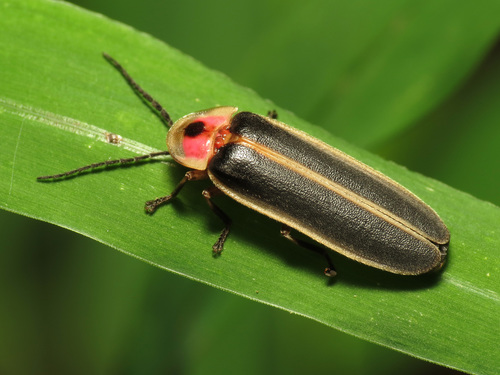
Common Eastern Fireflies (Photinus pyralis) are at peak emergence and breeding display during the longest nights of early summer, flashing in coordinated patterns to find mates in Nashville's riparian zones.
Along the low edges of Shelby Bottoms, where the sycamores and box elders hold the humidity close to the ground, the light goes out slowly this time of year. The days are as long as they get. And then, in the half hour after the last color leaves the sky, the fireflies begin.
The common eastern firefly is the one you are most likely watching. It is the species that appears first in the evening, typically within twenty to forty minutes after sunset, and it is the one producing that familiar slow arc of yellow-green light. The male flies upward in a gentle J-shaped path, flashes once at the top of the arc, then waits. If a female perched in the grass or low vegetation below sees the flash and answers with her own after about two seconds, the male turns toward her and the exchange continues until he finds her. The timing matters. Each firefly species has its own flash interval, its own delay between call and response, and its own characteristic color and duration of light. The common eastern firefly's flash lasts roughly half a second. The gap between flashes is about five to six seconds. These specifics are what allow a female to recognize her own species in a field where several species may be active at once.
The light itself is produced in the firefly's abdomen, in a layer of cells that contain two compounds, a substrate and an enzyme, that react together in the presence of oxygen to release energy almost entirely as light rather than heat. The firefly controls the flash by regulating the airflow to those cells through its breathing tubes. What looks like a casual signal from a distance is a precisely timed muscular event. Females of some other firefly species mimic the response flash of different species to lure males and eat them, but the females of the common eastern firefly do not do this. They are waiting for the right interval, the right color, the right duration.
The riparian corridors around Shelby Bottoms suit this species well. Common eastern fireflies spend most of their lives as larvae in moist soil and leaf litter, where they hunt earthworms and small invertebrates through the fall, winter, and spring. The adults that are flying now have not eaten since emerging. They live only three to four weeks in their adult form, long enough to find a mate and lay eggs in the soil before dying. The larvae that hatch from those eggs will overwinter underground and pupate next spring, completing a cycle that depends entirely on having damp ground and sufficient organic matter in the soil. Mowed turf, compacted soil, and dry upland sites produce almost no fireflies. The places along the Cumberland River corridor where the leaf litter is deep, where water sits in the low spots after rain, where the understory is open enough to fly through but dense enough to perch in: those are the places.
Light pollution affects them. Males navigating by the faint flash of a female in dark grass have difficulty distinguishing her signal from the ambient glow of a lit parking lot or a streetlight filtered through leaves. Research on this is ongoing, but the effect on display behavior is measurable. The firefly populations at Shelby Bottoms benefit from the relative darkness of the greenway corridor, buffered from the surrounding city by the tree canopy and the river. On a clear night away from the main paths, the display can be dense enough that the flashes overlap and stack.
If you are outside right now, or near a window, look toward any low-lying vegetated area, especially where the ground stays damp. The flashes appear at roughly the height of your knees to your chest, rising and falling in that slow arc. Watch for the pause after the flash. Somewhere in the grass below, a female may be answering.
