June 25, 2026
More details ↓
Native bees and native wildflowers in peak summer pollination, a direct relationship between a specialist bee and its preferred flowering plants during breeding season.
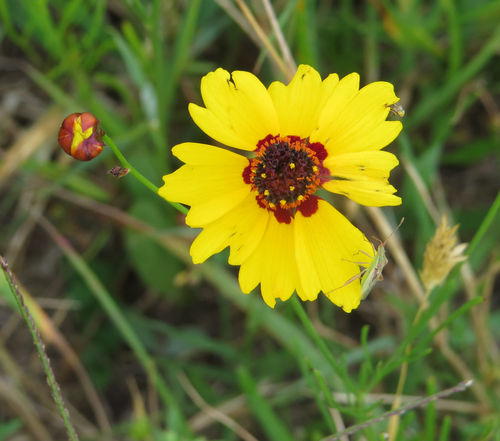
Plains coreopsis is flowering now across the open ground near Oklahoma City's central district, its yellow and burgundy heads standing a foot or two above the soil on wiry stems. Where a patch of it grows in full sun, you may hear a low, steady buzzing before you see what's producing it. That sound belongs to the hibiscus turret bee, and this is the center of her summer.
The hibiscus turret bee is a stocky, densely furred native bee, roughly the size of a small bumble bee, and she is a specialist. She does not range across whatever flowers happen to be blooming. She targets plants in the mallow family, particularly native hibiscus, but she also works coreopsis heavily during summer, gathering pollen in dense masses on the specialized hairs of her hind legs. She builds her nest in bare or sparsely vegetated soil, and at the entrance she constructs a short turret of soil pellets, a chimney a centimeter or two tall, which gives her her name. The turret may help keep water out during summer rains, or it may serve as a marker. Researchers are not entirely settled on its function, but the structure is distinctive enough that if you find one in a bare patch of ground near flowering plants, you are likely looking at her work. Inside the nest, she provisions individual cells with a mixture of pollen and nectar, lays a single egg on each provision mass, and seals the cell. The larva develops on that stored food without any further attention from the mother.
Plains coreopsis is well suited to this relationship. It is a native annual that thrives in disturbed, open ground, exactly the kind of habitat found along roadsides, field margins, and the edges of parks like Will Rogers. It produces pollen in quantity across a long summer bloom period, which aligns with the hibiscus turret bee's active season. The flower's open, flat-faced structure makes pollen accessible without requiring a bee to force its way inside. The bee moves across the disk flowers at the center of each head, vibrating her flight muscles against the anthers in a behavior called buzz pollination, which shakes loose pollen that would otherwise stay packed tight. Not every bee can do this. The western honey bee, which is an invasive species in North America, cannot buzz pollinate and so takes less pollen from coreopsis than native bees like this one. The turret bee's visits are more productive for the plant as a result: more pollen transferred, more seeds set.
The American bumble bee, which is listed as threatened, also works coreopsis this way during summer, and the two species can sometimes be found on the same patch of flowers. The bumble bee colony is at peak size now, the queen having started her workers in spring, and the workers are ranging out across whatever bloom is available. The hibiscus turret bee is solitary; there is no colony, no shared labor. Each female provisions her own nest, and the males, which emerge earlier in the season, are no longer part of the picture. What you see on the flowers now is a female at the height of her reproductive effort, moving from head to head, packing pollen, returning to a nest you almost certainly cannot find unless you are watching very carefully where she lands.
If you are near a patch of coreopsis right now, stop and watch for a moment. The bee arrives fast, drops onto a flower head, and the buzzing changes pitch slightly as she vibrates against the anthers. She works the disk methodically, a few seconds per flower, then lifts and crosses to the next stem. The yellow pollen accumulates visibly on her legs as she works. When the load is large enough, she heads back toward bare ground somewhere nearby. The whole sequence, from arrival to departure, takes less than a minute. The sun is high and the flowers are fully open, which is when the pollen is most available. The buzzing, once you locate it, is easy to track.
