June 27, 2026
More details ↓
How pipevine swallowtail caterpillars sequester poison from their native host plant to become unpalatable to predators, a relationship visible in early summer as eggs and young larvae appear on snake apple vines.
Along the rocky slopes and cedar edges near Austin, snake apple vines are climbing whatever they can find right now. The stems are thin and wiry, the leaves deeply lobed, and the small yellow-green fruits hang where flowers were a few weeks ago. It is easy to walk past this plant without stopping. But look closely at the undersides of the leaves, and in early summer you may find what you are looking for: small clusters of rust-orange eggs, each one the size of a pinhead, laid in tight groups by the pipevine swallowtail.
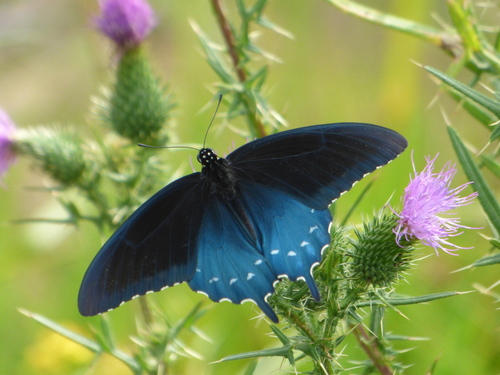
The pipevine swallowtail is a large butterfly, dark-winged with an iridescent blue-green sheen on the hindwings that catches the light when it moves through dappled shade. The adults nectar widely, visiting wax mallow and other open flowers in the heat of the day. But for laying eggs, the female is specific. She seeks out snake apple, and a handful of other native pipevines in the region, because the plant contains aristolochic acids, a group of compounds that are toxic to most insects and to vertebrates. The caterpillars that hatch from those orange eggs are not harmed by these compounds. Instead, they eat the leaves and incorporate the acids into their own tissues.
The caterpillars start small and dark, almost black, with rows of fleshy orange tubercles along their backs. As they grow through their instars, the color intensifies. By the time they are fully grown, they are conspicuous: dark brown to reddish-black, those orange knobs prominent, the body thick and slow-moving on the vine. This is not camouflage. The coloration is a signal. Birds that have tried eating one of these caterpillars, or the adult butterflies that emerge from them, learn the association. The bright colors and the bad taste reinforce each other. A blue jay that samples a pipevine swallowtail larva once tends not to try again.
What makes this relationship ecologically interesting is how it extends beyond the two species directly involved. Several other butterfly species in this region, including the red-spotted purple and certain female tiger swallowtails, have wing patterns that closely resemble the adult pipevine swallowtail. They do not carry the aristolochic acids themselves, but they benefit from the learned aversion that predators have developed toward the pipevine's coloration. The pipevine swallowtail is the anchor of that mimicry system, and the anchor depends entirely on snake apple being present in the landscape.
Snake apple is a native vine of the Texas Hill Country and the Edwards Plateau, well adapted to thin limestone soils and summer drought. It dies back to a tuberous root in winter and leafs out again in spring, which is why the pipevine swallowtail's egg-laying tracks the vine's growing season so closely. The female butterfly is not simply finding a food source; she is finding the one plant whose chemistry her offspring can use. How she locates individual vines, which can be sparse and scattered across a landscape, is not fully resolved, but contact with the leaf surface appears to trigger the decision to lay. She lands, drums with her forelegs, and within seconds either moves on or begins depositing eggs.
Right now, in the long days of early summer, the vines are in full leaf and the first egg clusters are appearing. If you find a snake apple vine and check the undersides of several leaves, you may find eggs, young larvae, or the characteristic feeding damage where a caterpillar has taken irregular bites from the blade. The caterpillars do not strip a plant bare; they move between leaves, and a healthy vine can support a small cohort without losing too much tissue. The relationship is close but not destructive, calibrated over a long association between this butterfly and the plants in this genus.
The air near Austin is thick and warm by mid-morning now, and the light comes down hard through the cedar and oak. Somewhere in the scrubby edges, a pipevine swallowtail is working the understory, wings tilting as it moves from shade to sun and back again.
