June 26, 2026
More details ↓
Large solitary bees excavating tunnels in dead wood during peak breeding season, a visible and tangible nesting behavior happening now in the longest days of summer.
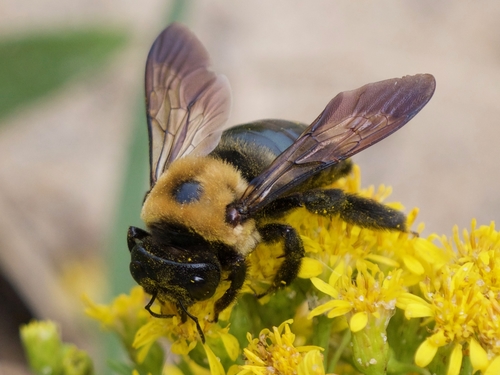
Somewhere near a wooden fence post, a porch railing, or the underside of a dead branch, a large black-and-yellow bee is chewing. Not collecting. Not visiting flowers. Chewing. The eastern carpenter bee is in the middle of its nesting season right now, and the long days of summer are when that work is most visible and most audible if you get close enough to hear it.
Eastern carpenter bees are big. The females are the ones doing the excavating, and they are roughly the size of a bumblebee, though their abdomen is shiny and black rather than fuzzy. A female will select a piece of dry, unpainted, or weathered wood and begin boring straight in, then turning ninety degrees to run a tunnel along the grain. She uses her mandibles, not any kind of chemical process, and she does this alone. These are solitary bees. There is no colony, no queen in the social sense, no workers. A single female excavates her own tunnel, which can extend several inches, and provisions each brood cell inside it with a ball of pollen and nectar before laying one egg and sealing the chamber. She may reuse the same tunnel year after year, or extend an old one, and over time a single piece of wood can hold a network of galleries from multiple generations of females.
The males are conspicuous in a different way. They have a yellow face patch, and they hover in open areas near nesting sites, often returning to the same post or corner of a structure day after day. If you pass close by, a male may fly directly at you and hold position a foot from your face. This is territorial display, not attack. Male carpenter bees have no stinger. The females do, but rarely use it unless physically handled. The hovering, the sudden approach, the held position, these are the full extent of male defense.
For the ecosystem around Central City, carpenter bees are significant pollinators of summer-blooming plants. They are what is called buzz pollinators: a female grips a flower and vibrates her flight muscles at a frequency that shakes pollen loose from anthers that would not release it through simple contact. Tomatoes, blueberries, and several native wildflowers depend on this behavior. Carpenter bees also practice nectar robbing, cutting a slit at the base of tubular flowers to reach nectar without contacting the anthers at all. So the same individual may be a pollinator on one plant and a nectar thief on the next. The relationship with any given flower depends on its shape.
Other bees are working the same plants right now. Common eastern bumble bees and brown-belted bumble bees are both present in this area, also buzz pollinators, also active through the summer peak. The American bumble bee is here too, though in smaller numbers and flagged as a species of concern. The western honey bee, which is invasive and not native to North America, is present as well. These species overlap in the flowers they visit, but carpenter bees are unusual among them for nesting in wood rather than in ground cavities or existing structures. That nesting habit is what makes them so visible right now. The wood is the evidence.
Woodpeckers notice the galleries. Red-bellied woodpeckers are active in this area, and they are known to excavate carpenter bee tunnels to reach the larvae inside. A tunnel that took a female days to bore and provision can be opened from the outside in seconds. Whether the larvae survive depends largely on whether the woodpecker finds the gallery before the egg hatches and the larva develops. The female bee, once she has sealed the cell, does not guard it.
If you are near any weathered wood right now, look for a perfectly round hole, roughly the diameter of your finger. The edges will be clean, not ragged. If the tunnel is active this season, there may be a small pile of pale sawdust below it, fresh and dry. That is where the work is happening.
