June 26, 2026
More details ↓
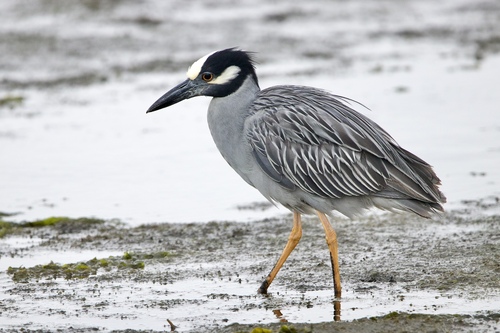
Yellow-crowned Night Herons, a threatened wading bird, actively forage in coastal waters during summer months, timing their hunting to exploit prey abundance in warming shallows.
The tidal shallows near Palm City sit warm and still in the summer heat, the water temperature pushing past 30 degrees Celsius, the surface barely moving. Where cordgrass and pickerelweed give way to open mud and shallow pools, a yellow-crowned night heron stands at the edge, motionless, watching the bottom.
The yellow-crowned night heron is a threatened species in Florida, and one of the more specialized hunters among the wading birds. Where great egrets and white ibis work the shallows with a kind of general opportunism, the yellow-crowned night heron focuses almost entirely on crustaceans. Fiddler crabs, mud crabs, crayfish: these are the core of its diet. Its bill is heavier and more blunt than most herons, built to crush hard shells rather than spear fish. The bird's eyes are large and set well forward, giving it the binocular precision it needs to track a crab moving across a mudflat. It will stand without moving for long stretches, then shift one foot forward, then stop again. When it strikes, it does so with the full weight of the neck behind the bill, driving straight down.
Summer is when this hunting is most productive. The warming water accelerates crab activity. Fiddler crabs emerge from their burrows in larger numbers on warm afternoons, and the tidal flats around the St. Lucie River estuary and the Indian River Lagoon offer exactly the kind of habitat these herons depend on: shallow, soft-bottomed, and sheltered from wave action. Unlike many wading birds that concentrate their foraging in the early morning, yellow-crowned night herons are crepuscular and nocturnal hunters, most active at dusk and through the night. The name is accurate. In summer, with long warm nights, they have more hours to work the shallows than at any other time of year. You may have already seen one standing at the waterline near dusk, gray and pale-faced, so still it reads at first as a stump or a post.
This summer is also nesting and fledging season for wading birds across the region. Yellow-crowned night herons nest in small colonies, often in mangroves or dense shrubs close to foraging habitat, and the adults are feeding chicks now or have recently pushed juveniles toward independence. Young birds are streaked brown, nothing like the clean gray and white of adults, and they are less efficient hunters. They miss more strikes. They spend more time at the water's edge learning the rhythm of a crab's movement before it retreats into the mud. The adults continue to forage heavily through the summer to recover the energy spent on nesting, and the juveniles are learning the same tidal flats their parents use.
Green herons work similar edges here, smaller and more secretive, sometimes using a dropped feather or a floating object as a lure to draw small fish within reach. The two species share the shoreline without much direct competition: the green heron takes fish and invertebrates at the surface, the yellow-crowned night heron focuses lower, on the bottom-dwelling crabs. Both are reading the same water, responding to the same tidal rhythm, but targeting different animals in different layers.
The shallows here also hold loggerhead sea turtles moving through coastal waters during summer nesting season, cownose rays passing over the grass flats, and the occasional bull shark working the deeper channels. These animals occupy the same estuary but at different scales and depths. The night heron's world is the margin, the few inches of water above the mud where crabs move and the light, even at night, reflects off a pale shell.
The air is heavy this time of year, and the light drops fast in the evenings. If you are near the water as the sun goes down, listen for the night heron's call: a short, sharp bark, higher-pitched than you might expect from a bird this size. It carries across open water. The bird may be visible at the shoreline, or it may already be working the far edge of the flat, just a gray shape moving slowly through the last of the light.
