June 24, 2026
More details ↓
As common milkweed flowers emerge across the Kingston area, monarch caterpillars are actively feeding on its leaves—a relationship essential to the monarch's life cycle and threatened by habitat loss.
The common milkweed along roadsides and field edges near Kingston is in flower right now. The blooms come in dense, rounded clusters, pale pink to dusty rose, and they smell strongly sweet in the heat of the day. If you find a patch, look down at the leaves before you look up at the flowers. On the broad, rubbery leaves, you may find monarch caterpillars feeding. They are banded in yellow, white, and black, and they eat with their heads down, working steadily through the leaf tissue from the edge inward.
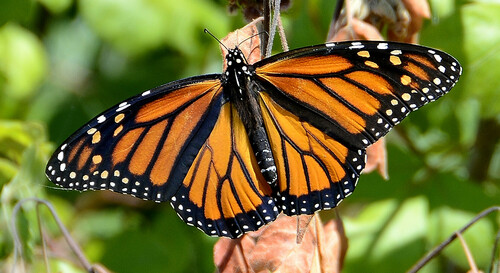
The monarch's relationship with common milkweed is one of near-total dependence. Adult monarchs lay their eggs almost exclusively on milkweed plants, and the caterpillars eat nothing else. The plant produces a sticky white latex sap loaded with cardenolides, a class of compounds toxic enough to disrupt heart function in most vertebrates. The caterpillar takes those compounds in as it feeds and stores them in its own tissues. By the time it pupates, a monarch is chemically defended against most birds. A blue jay that eats a monarch caterpillar or butterfly typically vomits within minutes. After that, it avoids the banded pattern. The milkweed's defense, which evolved to deter feeding, becomes the caterpillar's protection.
The timing of egg-laying tracks the milkweed closely. Female monarchs arriving in the Kingston area in late spring and early summer are looking for young, actively growing milkweed plants. The younger leaves are easier to chew and carry higher concentrations of water and nitrogen, both of which the caterpillar needs to grow. A monarch caterpillar increases its body mass roughly two thousandfold between hatching and pupation, and it does that in about two weeks. You can sometimes find a caterpillar that has nearly defoliated a single stem, the remaining leaf stubs chewed to their midribs, while the caterpillar hangs at the tip still eating. When a stem is stripped, the caterpillar drops and walks to the next plant. Watch the ground around a milkweed patch and you may see one moving through the grass.
Common milkweed is doing something else in early summer besides feeding caterpillars. The flower clusters are producing nectar in quantity, and the blooms draw a wide range of insects: bumblebees, honeybees, various wasps, and other butterflies including the eastern black swallowtail, which is flying in the Kingston area now. The milkweed's flower structure traps visiting insects momentarily by the leg, transferring pollen sacs that the insect carries to the next flower. It is an unusually mechanical pollination system, and it occasionally holds a small bee long enough to exhaust and kill it. The plant is not passive.
Monarchs are listed as threatened, and the pressures on them are well documented: the loss of milkweed from agricultural fields following the widespread adoption of herbicide-resistant crops, the reduction of overwintering habitat in Mexican mountain forests, and the fragmentation of the grassland and old-field habitats where milkweed grows. Common milkweed is a plant of disturbed, open ground. It thrives in the kinds of places that tend to get mowed, paved, or treated: roadsides, utility corridors, fallow fields, garden edges. Milkweed patches near Kingston that persist through the summer without being cut give monarchs a place to complete their cycle. A single patch of a dozen plants can support multiple caterpillars through to pupation.
The invasive spotted knapweed is also present in open areas around Kingston, and it competes directly with milkweed for space in the disturbed-ground habitats both species favor. Knapweed establishes densely and can displace native forbs over several seasons. It is worth knowing what it looks like: a branching plant with narrow, grayish-green leaves and small thistle-like purple flowers later in summer. Where it crowds out milkweed, the monarchs lose footing.
Right now, in the warmest part of the day, the milkweed flowers are releasing their scent most strongly. Stand near a patch and you can smell it before you see it. The leaves are broad and slightly waxy, and if you look at the underside of one, you might find a pale monarch egg, about the size of a pinhead, glued to the surface. Or you might find a caterpillar already there, working through the green.
