June 25, 2026
More details ↓
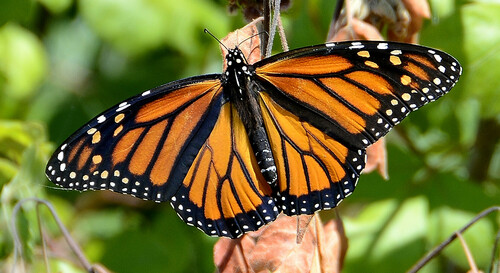
Monarch butterflies are laying eggs on milkweed plants now as breeding season peaks, and their caterpillars are actively feeding in response to the host plant's summer growth.
The milkweed plants along the edges of Redwood City's open areas are at full summer growth right now, their broad leaves thick and upright in the long afternoon light. If you find one, look closely at the undersides. You may see a small clutch of pale, ridged eggs the size of a pinhead, or a caterpillar working its way across the leaf surface in alternating bands of white, yellow, and black.
Monarchs are laying eggs here now, at the peak of the summer breeding season. A female finds milkweed by landing and pressing the tarsi of her forelegs against the leaf surface. She is tasting it. Milkweed produces cardenolides, a group of toxic steroids that most insects cannot process. The monarch can, and has built its entire life cycle around that fact. Once she confirms the plant, she lays a single egg on the underside of a leaf, often choosing younger, softer growth that a newly hatched caterpillar can manage. She will visit dozens of plants over the course of a day, distributing her eggs widely rather than concentrating them in one spot.
When an egg hatches, the caterpillar's first meal is often the egg casing itself. Then it begins on the leaf. It feeds steadily and grows through five distinct stages over roughly two weeks, shedding its skin between each one. The cardenolides it ingests do not harm it. They accumulate in its tissues instead, making the caterpillar unpalatable to most predators. The bold banding is part of this arrangement: the pattern is a signal, and it works because predators that have tried a monarch caterpillar once tend not to try again. A scrub-jay that takes one and spits it out is less likely to take another. The caterpillar does not hide. It feeds in the open.
Common milkweed, the species most associated with monarchs in the eastern part of their range, is present in this area in cultivated and naturalized patches. In California, monarchs also use narrowleaf milkweed and showy milkweed, both native to the state. The relationship is specific enough that where milkweed disappears from a landscape, monarchs stop breeding there. The plants have been reduced across much of California by land conversion, herbicide use, and the removal of roadside vegetation. Monarchs in California are listed as threatened, and their breeding populations have declined sharply over the past several decades. The patches that remain, including those near Redwood City, carry real weight in the regional picture.
The adult monarchs you may see nectaring right now are not the same individuals that will migrate south in late summer. The ones flying today are summer breeding adults. They will lay eggs, and some of their offspring will eclose as adults in time to make the migration to the California coast, where monarchs overwinter in groves of eucalyptus and Monterey pine. The migratory generation lives longer and does not reproduce until the following spring, when it moves inland again to find milkweed and begin the cycle. The summer generation and the migratory generation are physiologically different, though they are the same species. What determines which type a caterpillar becomes is still not fully resolved.
Anna's hummingbirds are working the flowers nearby, and western honey bees, an invasive species established throughout California, are foraging on the same blooms. Neither has much to do with the monarch's breeding, but both are present in the warm air above the same patch of ground. The toyon along the slope is in open flower right now, and its small white clusters are drawing insects from several directions.
If there is milkweed near you, the caterpillars, if present, will be visible in daylight, feeding steadily on the leaf surface. The plant itself has a faint, slightly bitter smell where the stem is broken. The caterpillar feeding on it does not smell like much at all. What you notice is the movement: a slow, deliberate chewing that works across the leaf from one edge inward, leaving a clean margin behind.
