June 24, 2026
More details ↓
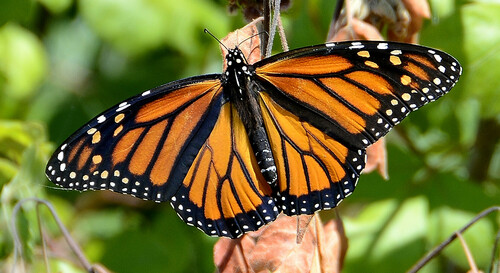
Female monarch butterflies are arriving in the Wexford area during peak egg-laying season, seeking milkweed plants that are now fully leafed out and ready to nourish their caterpillars.
The milkweed along the roadsides and field edges near Wexford is fully leafed out now, the broad leaves a deep, waxy green in the early summer light. This is what a female monarch has been looking for since she arrived from the south. She doesn't stop at every plant. She lands, drums the leaf surface briefly with her forelegs, and moves on, or she stays. That tapping is how she tastes the plant, detecting the chemical signature of milkweed before she commits to laying.
Monarchs are the only butterfly in this region that can complete their life cycle on milkweed, and common milkweed is the plant most available to them here. The relationship is specific and tight. Milkweed produces cardenolides, a class of toxic compounds that make the leaves unpalatable to most insects and dangerous to vertebrates. Monarchs have a tolerance for these compounds that other butterflies lack. A female will lay a single egg on the underside of a leaf, usually a young leaf near the top of the plant where the cardenolide concentration is slightly lower. She may lay hundreds of eggs over the course of a few weeks, rarely more than one per plant, spreading the clutch across as many milkweed stems as she can find.
The egg hatches in three to five days. The caterpillar's first meal is often the eggshell itself, then the leaf. As it feeds and grows through five instars, it accumulates the cardenolides in its own tissue. By the time it pupates, the toxins are concentrated enough that a bird that eats it will become nauseated. Most birds learn quickly. The bright yellow, black, and white banding of the caterpillar is not camouflage; it is a signal that this animal costs something to eat. The adult butterfly carries those same compounds, which is why the orange and black wings are worth recognizing. The great spangled fritillary, also flying now near Wexford, shares some of that orange coloration, though it is a different animal entirely with different habits and a different larval host. The visual overlap is real but loose.
What the milkweed gets from the monarch is less obvious, but the plant does produce nectar in the flower clusters that are beginning to open now, and monarchs, like other butterflies, visit those flowers. Milkweed pollen is packaged in sticky masses called pollinia that attach to the legs of visiting insects and are carried to the next flower. Monarchs are among the insects that move this pollen, though they are not the primary pollinators. The plant's reproductive success doesn't depend on them the way the monarch's does on the plant.
The pressure on this relationship comes partly from habitat. Common milkweed grows in disturbed ground, field margins, roadsides, and patches of open land between woodlots. Near Wexford, that open ground is also where invasive plants like purple crownvetch and Morrow's honeysuckle establish themselves, both of which are present in this area now. Crownvetch, an invasive ground cover, spreads in dense mats across the same roadsides and disturbed edges where milkweed would otherwise grow, reducing the area available to it. Milkweed is resilient and spreads by both seed and underground rhizome, but it competes for the same light and soil. Fewer milkweed plants in the landscape means fewer places for a female monarch to lay, fewer caterpillars to complete their cycle, fewer adults to make the fall migration south.
If you're near an open edge or a field margin right now, look for milkweed in the knee-high vegetation. The leaves are large and paired, the stems thick, and if you look closely at the undersides of the upper leaves, you may find a pale yellow egg no larger than a pinhead. The female that laid it may still be nearby, moving from stem to stem with that deliberate, unhurried flight, tapping and tasting before she decides.
