June 26, 2026
More details ↓
Least terns, Maine's smallest tern species, are at peak nesting season in early summer, relying on bare sand and gravel substrates while facing pressure from human disturbance and predation.
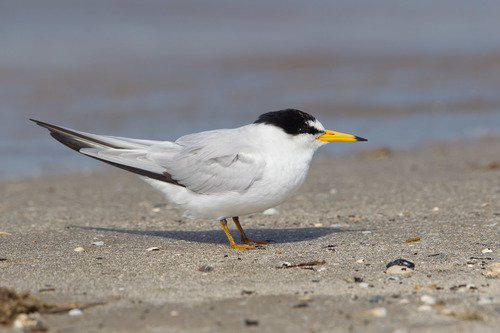
Along the sandy margins near South Portland, the least terns are working. You can hear them before you see them — a sharp, insistent kip-kip-kip carrying over the water, pitched higher than anything else calling from the shore. They are Maine's smallest tern, barely larger than a starling, with a yellow bill tipped in black and a white forehead patch that catches the early summer light. At this time of year, they are doing something that looks, from a distance, almost unreasonably exposed: nesting directly on bare sand and gravel, in the open, with no structure around them at all.
The nest is a shallow scrape, sometimes lined with a few bits of shell or debris, sometimes nothing. The eggs sit in it and look like the ground itself, pale and speckled in shades of tan and gray. A colony may have a dozen or more of these scrapes within a short stretch of beach, each pair defending a small radius around their eggs with considerable noise and direct aerial aggression toward anything that enters. The terns fish constantly during this period, plunging into the shallows for sand lance and small silversides, then returning to trade off incubation duties. The longest days of the year give them more hours to do this, and they use them. A pair may make dozens of foraging trips in a day, each one a brief steep dive and a quick return to the colony.
The colony's main vulnerability is its openness. The same bare substrate that makes the eggs hard to see from above makes the birds easy to flush from the ground. A person walking too close will lift the adults off the nest, leaving the eggs exposed to sun and, more critically, to the attention of herring gulls, which are present along this coastline in numbers and will take eggs and chicks when the opportunity is there. Crows present the same problem. The terns respond to these threats collectively — the whole colony rises and mobs the intruder — but sustained disturbance breaks that defense down. Repeated flushes during incubation can cause nest abandonment, and early summer here brings both foot traffic and the birds that follow it.
Peregrine falcons hunt this coastline. A peregrine is capable of taking a tern in flight, and when one appears near a colony the response is immediate: the terns go up in a tight, fast-moving group, calling hard, and the structure of the colony dissolves temporarily into a single defensive mass. The peregrine is not focused on the colony the way a gull is — it is a fast pursuit predator, and a healthy, alert colony of small birds is not easy prey — but the disruption is real and the energetic cost of repeated alarm responses adds up across a nesting season. The terns have to balance time away from eggs against the risk of leaving them unguarded, and a persistent predator presence shifts that balance.
Least terns are a threatened species in Maine, and their numbers here reflect the broader pressure on sandy beach nesting habitat along the New England coast. The beach plum along the upper margins of the shore is leafed out now, and the gray alder has filled in behind it. That vegetation line marks the edge of usable tern habitat — the birds need the open ground in front of it, and as that ground shrinks or fills with foot traffic, colonies compress or fail. What sustains the ones that do persist is the fidelity of the birds to specific sites; least terns return to the same colony locations year after year, which makes successful sites worth protecting and failed ones genuinely hard to replace.
If you are near the water right now, listen for that kip-kip-kip above the low wash of the shore. The terns are small enough that you might look past them, but once you pick up the call, you will start to see the wingbeats — quick and stiff, with that distinctive hovering pause just before the dive.
