June 24, 2026
More details ↓
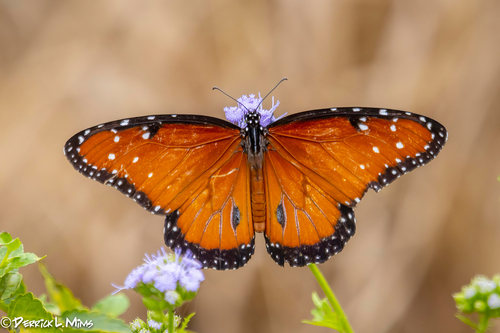
Adult queen butterflies are actively visiting desert willow flowers during peak summer bloom, a pollinator-plant relationship anchored to a specific flowering moment.
Along the dry washes and canyon edges near Tucson, the desert willow is in full bloom right now. Its flowers are large and trumpet-shaped, pink to lavender with yellow streaking inside the throat, and they open in flushes through the longest days of summer. The tree itself is not a true willow — it belongs to a different family entirely, one more closely related to catalpa — but it grows where willows often do, in the sandy beds of intermittent streams where water moves underground even when the surface is dry. In this heat, with the air shimmering off bare gravel, the flowers are one of the more reliable nectar sources in the landscape.
Queen butterflies are working those flowers right now. They are large and richly colored, deep mahogany-orange with black borders and small white spots along the wing edges. If you are near any flowering desert willow, watch for them — they move deliberately from bloom to bloom, hovering briefly before landing and extending their proboscis into the flower tube. The queen is closely related to the monarch, similar enough in appearance that the two are sometimes confused, but the queen's wings lack the monarch's bold black veining across the orange field. Queens are year-round residents in the Sonoran Desert, not migrants, and summer is their breeding peak. The adults feeding now are building the energy reserves that will support egg-laying through the hottest weeks of the year.
The desert willow's flower shape is not incidental to this relationship. The trumpet is wide enough to admit a large butterfly, and the yellow-streaked interior guides visitors toward the nectaries at the base of the tube. When a queen lands and pushes its head into the flower, it contacts the anthers and picks up pollen on its body. Queens visit many flowers in sequence, and that movement carries pollen between individual trees. Desert willow depends heavily on large pollinators — hummingbirds work the same flowers, and black-chinned hummingbirds are present in this area now — but butterflies like the queen are consistent visitors through the summer months when hummingbird activity can be less predictable. The tree blooms repeatedly through summer, producing new flower clusters as old ones drop, which keeps the relationship active for weeks rather than days.
Queens also have a relationship with a different set of plants entirely, and it runs parallel to the pollination story without overlapping it. The caterpillars feed on milkweeds, and the adults seek out milkweed and related plants not just to lay eggs but to obtain alkaloids called pyrrolizidines, which the butterflies sequester in their bodies. Males use these compounds in courtship; the chemicals signal something about the male's quality or persistence. This is separate from what is happening at the desert willow flowers, but it means the adult butterflies are navigating a landscape of multiple plant relationships simultaneously — nectaring here, seeking out milkweed there, all within the same summer afternoon.
Creosote bush is also flowering nearby, its small yellow blooms open in the same heat. The Mediterranean mantis, an invasive species established in the Sonoran Desert, is present in this area and hunts among flowering vegetation, ambushing visiting insects including butterflies. It is worth knowing that not every visit to a flower ends in a successful departure. The queens that complete their rounds and move on are the ones building the next generation.
The light this time of year comes down hard and direct at midday, and the desert willow's canopy, thin and feathery, does not cast much shade. The flowers show up clearly against that bright sky. If one is blooming near you, watch the flowers for a minute. The wings of a feeding queen open and close slowly while it drinks, the mahogany color catching the full sun.
