June 25, 2026
More details ↓
Monarch caterpillars are entering their peak feeding stage on newly opened common milkweed flowers—the only host plant they can eat—at the height of early summer when both are synchronized in the landscape.
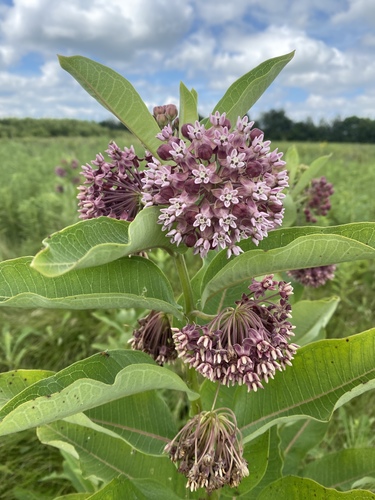
The common milkweed patches near Westfield Center are in full bloom right now. The flower clusters are dense and rounded, each one packed with small pink-purple florets that smell faintly sweet in the heat of midday. Look closely at any milkweed stem and you may find what you're looking for: a monarch caterpillar, banded in yellow, black, and white, working its way through the plant with steady, methodical biting.
Monarchs lay their eggs on common milkweed and nothing else. The caterpillar that hatches has one food source, and this is it. What makes this relationship so specific is chemistry. Common milkweed produces cardenolides, a class of compounds that are toxic to most animals. The monarch caterpillar not only tolerates them but sequesters them in its own tissues, which makes the caterpillar itself unpalatable to most predators. Blue jays, which are foraging through the shrubs and trees nearby right now, have learned through experience to avoid monarchs. A jay that eats one typically vomits and does not repeat the mistake. The caterpillar's bold banding is the signal that enforces that lesson.
The timing of the caterpillar's peak feeding stage and the milkweed's flowering is not coincidental. Monarch adults arrive in this part of Massachusetts in early summer, when milkweed plants are mature enough to support larvae but still actively growing. The flowers themselves are part of the caterpillar's diet. Early instars tend to feed on the undersides of leaves, where the leaf tissue is thinner and easier to chew. But by the third, fourth, and fifth instars, a caterpillar will consume entire leaves, flower buds, and open florets. The flowers are high in sugar and protein relative to the leaves, and a caterpillar in its final instar before pupation can consume a full milkweed leaf in under an hour. What you see on a milkweed plant in early summer is not just feeding; it is a caterpillar building the fat and protein reserves it will need to complete metamorphosis and, if it is a late-summer individual, to fuel a migration of more than a thousand miles.
Common milkweed does more than feed monarchs. The flowers produce nectar that draws a wide range of insects, including native bees, wasps, and beetles, some of which are also pollinators. The plant's pollination mechanism is unusual. Pollen is packaged in small sacs called pollinia, which attach to the legs of visiting insects and are carried to other flowers. The plant depends on insects large enough to pull the pollinia free, which is why smaller insects sometimes get trapped in the flower's grooves and die there. American goldfinches, which are present along the reservoir edge nearby, will return to milkweed later in summer to pull the silky fibers from the seed pods for nest lining. The plant is used at multiple stages, by multiple species, for different purposes.
The monarch itself is under real pressure. Its population has declined sharply over recent decades, driven by habitat loss along its migration corridor and the reduction of milkweed in agricultural landscapes where herbicide use eliminated much of the plant that once grew along field edges. The patches near Westfield Center represent exactly the kind of rough, open, disturbed ground where common milkweed establishes well: roadsides, field margins, areas where the soil has been turned or the canopy is thin. These are not pristine habitats, but they are functional ones.
If you are near a milkweed patch right now, the smell of the flowers carries a short distance in warm air. Bend close to one of the flower clusters and you can see the individual florets, each with a small raised corona. Run your eye down the stem to where the leaves attach, and check the underside of a leaf for the pale, ridged sphere of an egg, or the small striped body of a young caterpillar just beginning to feed. The milkweed is at its peak, and the window for this particular stage does not stay open long.
