June 24, 2026
More details ↓
Early summer is when threatened Blanding's turtles emerge from wetlands to find dry ground for egg-laying, a vulnerable journey that defines their breeding season.
The wetlands near Clarksville are full right now. Water levels are high from spring rains, aquatic insects are emerging in clouds above the surface, and the days are at their longest. In this kind of light, if you watch the edge of a marsh or slow creek long enough, you might see a dome-shaped shell moving through the shallows toward shore. It is early summer, and the Blanding's turtles are nesting.
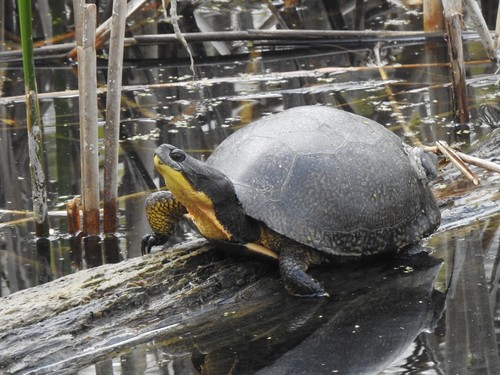
The Blanding's turtle is a threatened species, and the wetlands around here are part of its core range in Michigan. It is a medium-sized turtle, recognizable by its bright yellow chin and throat, and by the high, rounded profile of its dark shell, which is often speckled with small yellow flecks. For most of the year, Blanding's turtles stay in the water, hunting crayfish, aquatic insects, and small fish in marshes, ponds, and sluggish streams. But in early summer, females leave the water entirely. They walk overland, sometimes a quarter mile or more, to find open, sunny ground with loose soil where they can dig a nest and lay eggs. Sandy roadsides, field margins, gravel shoulders, disturbed ground near trails: these are the places they look for. The same places that put them directly in the path of vehicles and foot traffic.
A female Blanding's turtle may not nest until she is seventeen or eighteen years old. Once she starts, she returns to the same general area year after year, navigating by cues that researchers are still working to fully understand. She digs with her hind feet, deposits a clutch of six to twelve eggs, covers the nest, and walks back to the water. The nest is on its own after that. Incubation takes around sixty to seventy days, and the temperature of the soil during that period determines the sex of the hatchlings. Warmer nests produce more females. The hatchlings, when they emerge in late summer or early fall, are small enough to sit in a teaspoon, and they face an extraordinary number of predators: raccoons, foxes, skunks, crows. Nest predation rates in many populations run above eighty percent. The species persists because adults live so long and reproduce across so many decades, not because any single year goes well.
The landscape these turtles move through near Clarksville has changed considerably. Autumn olive, an invasive shrub, has spread densely through many of the open and edge habitats here. So have invasive multiflora rose and Morrow's honeysuckle. Together, these shrubs close off the sunny, open ground that nesting females need. A turtle emerging from a marsh and moving upslope into a thicket of dense shrub cover may not find suitable nesting soil at all, or may travel much farther than she otherwise would, crossing more roads and open ground in the process. The native woodland edge that once offered open patches under white oak and black oak is harder to find. Where it remains, near the sycamores along creek margins and in the drier oak uplands, nesting habitat still exists. But the corridor between water and nesting ground matters as much as either end of it.
Tree swallows and barn swallows are working the air above the wetland margins right now, catching the same emerging aquatic insects that Blanding's turtles hunt below the surface. Red-winged blackbirds are calling from the cattails. The marsh is loud and active. But down at the waterline, or crossing a gravel two-track somewhere nearby, a turtle may be moving slowly and steadily toward ground she has visited before. She is not fast. She does not need to be, in the water. Out here, her pace is the same regardless. Watch the edges of any open ground near the marsh. The soil is warm enough to feel it through your shoes.
