June 25, 2026
More details ↓
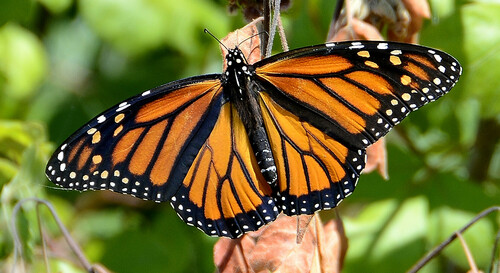
Female monarch butterflies lay eggs on common milkweed plants during the breeding season's height, ensuring the next generation has food when caterpillars hatch.
The common milkweed along the edges of White River State Park is in full leaf now, broad and upright, the stems thick with a white sap that bleeds if you snap one. This is peak summer in central Indiana, the longest days of the year, and the milkweed is doing exactly what monarchs need it to do: growing fast, producing new leaves, staying green and full of the compounds that make it both toxic and essential.
A female monarch finding a milkweed patch does not land randomly. She walks the leaves with her forelegs, which carry chemoreceptors sensitive enough to detect the plant's chemistry through contact. She is tasting the leaf before she commits. If the plant is right, she curves her abdomen and deposits a single egg on the underside of a leaf, pale green and ridged, smaller than a pencil eraser. Then she moves on, usually to a different plant, sometimes to a different patch entirely. A single female may lay several hundred eggs over her breeding season, but she spreads them deliberately. One egg per leaf, rarely more. This matters because a caterpillar that hatches has only so much leaf within reach before it needs to move, and if eggs are clustered, caterpillars compete.
The eggs hatch in three to five days, depending on temperature. The caterpillar that emerges eats its own eggshell first, then begins on the leaf. It feeds for roughly two weeks, molting through five distinct stages, each one larger and more boldly striped in yellow, black, and white. The milkweed's sap contains cardiac glycosides, compounds that are toxic to most vertebrates. The caterpillar does not detoxify them; it sequesters them, storing them in its own tissues. By the time it pupates, it is chemically defended, and the adult butterfly that emerges carries that protection forward. A bird that eats a monarch and gets sick will avoid the pattern afterward. The warning coloration is not decorative; it is the advertisement of something real.
Common milkweed is doing more than feeding monarchs right now. Its flowers, dense pink-purple clusters that bloom just before midsummer, draw a wide range of insects. The brown-belted bumble bee works milkweed flowers regularly, and the western honey bee, an invasive species introduced from Europe, is often present in the same patches. Milkweed flowers have an unusual structure: the pollen is packaged in small paired sacs called pollinia, and an insect visiting the flower can accidentally slip a leg into a groove and pull the whole structure free, carrying it to the next plant. The mechanism is passive on the plant's part, but it is precise enough that pollination depends on insects of a certain size and strength. Small insects sometimes get trapped by it.
The monarchs here are part of the eastern population, the one that overwinters in the mountains of central Mexico and moves north through the spring and into summer. The individuals laying eggs on Indianapolis milkweed now are likely two or three generations removed from the butterflies that left Mexico in spring. Each generation breeds and dies farther north, and it is the late-summer generation, not yet born, that will make the full return migration south. That generation will live for eight or nine months rather than the four to six weeks of a summer adult. What triggers the difference is not entirely settled, but shortening days and cooling temperatures in late summer are part of it.
If you are near any patch of milkweed right now, it is worth looking at the undersides of the leaves. The eggs are small enough to miss at a glance, but they are there if the monarchs have found this patch. Look for the ridged oval, pale green against the leaf's surface. The plant itself smells faintly sweet where the sap has dried on a broken stem. Somewhere in the warm air above, if you watch long enough, a monarch may drift through, angling low over the vegetation, checking what the summer has left for it.
