June 28, 2026
More details ↓
As daylight reaches its longest stretch, bold jumping spiders actively patrol and hunt insects across the landscape during peak breeding season, displaying the focused predatory behavior that makes them among the most visually acute hunters in the spider world.
The days near Paonia right now are as long as they get. Heat builds off the sagebrush flats by mid-morning, insects are everywhere, and if you look closely at a fence post, a rock face, or the broad leaf of a cottonwood, you may find a bold jumping spider looking back at you.
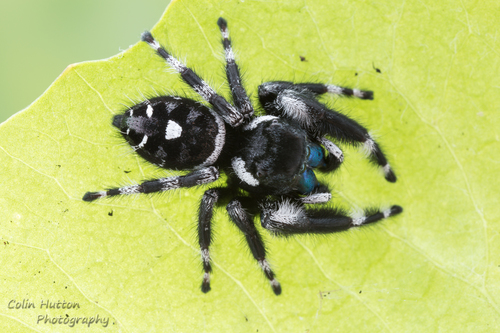
Bold jumping spiders are compact, heavy-bodied hunters, black with white and sometimes iridescent green markings, and rarely longer than a thumbnail. What sets them apart is their eyes. The front-facing pair is enormous relative to their body, and the visual acuity those eyes provide is exceptional among spiders. They can resolve detail and judge distance with enough precision to stalk and pounce on prey from several body lengths away. Unlike web-building spiders, which wait for prey to come to them, bold jumping spiders actively move through their environment: pausing, pivoting, tracking. When a fly lands within range, the spider turns to face it directly, fixes it with those forward eyes, and creeps closer before launching. The jump is controlled and short, and the spider drags a silk safety line as it goes, so a miss does not mean a fall.
This is peak season for them. Long days mean more insect activity across more hours, and the spiders track that activity. Around Paonia, they hunt across the sagebrush scrub and the drier rocky margins where insects concentrate on warm surfaces. Ten-lined June beetles are out now, large enough that a bold jumping spider would not attempt one, but the smaller flies, beetles, and moths that share this landscape are fair targets. The cottonwood stag beetle is similarly too large, but its presence signals the kind of decaying wood habitat that also shelters the small insects the spiders do take. Where the invasive broad-leaved sweet pea and purple crownvetch have established themselves along roadsides and disturbed margins, they draw in pollinators, and the spiders hunt at the edges of those patches too, taking whatever arrives. The spiders are not specialists. They take what they can catch.
Breeding activity is running alongside all of this hunting. Male bold jumping spiders court females with a precise visual display: the male faces the female, raises and waves his front legs in a specific pattern, and moves side to side. The female watches. Her response determines whether courtship continues or ends abruptly. Vision is the medium of the whole interaction, which makes sense given how much of their lives depend on seeing accurately. Females lay eggs in a silk retreat, often tucked under bark or behind a loose stone, and guard them until they hatch. The young spiders that emerge this summer will spend the rest of the season hunting and growing, overwintering as subadults, and reaching maturity the following year.
Other hunters share this landscape. Ash-throated flycatchers take insects on the wing from exposed perches. Western terrestrial garter snakes work the wetter margins. Blue-gray gnatcatchers pick small arthropods from leaf surfaces in much the same zones where jumping spiders patrol. The spiders are prey as well as predators. Birds take them when they can, and the spiders' habit of moving in open sight on sun-warmed surfaces makes them visible. Their response to a large moving shape is immediate: they turn to face it, drop to a lower surface, or hold still. That direct gaze, those big eyes tracking you, is the spider assessing whether to flee.
If you are near any sun-exposed surface right now, a wooden railing, a stone wall, the rough bark of a cottonwood, take a slow look. The spider will likely see you before you see it, and it will already be watching.
