June 26, 2026
More details ↓
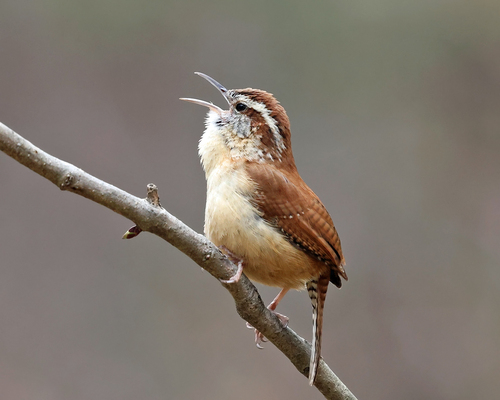
Northern House Wrens and Carolina Wrens are at peak breeding activity in midsummer, actively provisioning nestlings during the season's longest daylight hours when insect availability is highest.
The light in Sparta right now arrives early and stays late. By the time the dew is still on the grass, wrens are already moving. That is not incidental. The longest days of summer and the peak of wren breeding season land at the same time, and the overlap is not accidental — it is the whole point.
Two wren species are nesting near here simultaneously, and they are worth telling apart. The Carolina wren is the louder one, the one whose teakettle-teakettle-teakettle carries across a yard or woodlot with a confidence that seems outsized for a bird that weighs less than a AA battery. It nests low: in brush piles, in the cavities of rotting stumps, in the gap behind a loose board on a shed. It is a year-round resident in Tennessee, and it knows this ground. The house wren is smaller, plainer, browner, and its song is a long cascading chatter, bubbling and fast. It favors cavities too, but tends toward slightly more open habitat — woodland edges, brushy yards, the kind of place where a birdhouse on a fence post sits between mowed grass and a tangle of shrubs. Both species are actively provisioning nestlings right now, which means the adults are doing almost nothing except finding food and carrying it back.
What they are carrying is mostly insects. Caterpillars, beetles, spiders, grasshoppers, the occasional cricket. A pair of wrens with a full nest of nestlings may make several hundred foraging trips in a single day. That number is made possible by the hours of available light, which near the summer solstice stretch past fourteen hours in this part of Tennessee. More light means more foraging time. More foraging time means faster nestling growth. Wren chicks go from hatching to fledging in roughly two weeks, and the speed of that growth depends directly on how much protein the adults can deliver. The long days are not just convenient; they are the mechanism the breeding calendar is built around.
The two species divide the available habitat rather than compete head-on. Carolina wrens are more tolerant of dense cover and tend to stay in thicker vegetation year-round. House wrens are summer breeders here, arriving after the oaks have leafed out and leaving again in early fall. Where their territories overlap, there is some tension — house wrens are notoriously aggressive about nest cavities and will puncture the eggs of competitors, including other cavity-nesting species, to claim a site. The downy woodpecker also present in this area excavates the kind of holes that wrens are glad to inherit. Whether wrens and woodpeckers are tolerating each other near a particular snag right now is the kind of thing you can only find out by watching.
The insects both wrens depend on are everywhere in midsummer Sparta. The Pennsylvania dingy ground beetle moves through leaf litter at night and hides under debris by day — exactly the kind of prey a Carolina wren turns up by poking into low tangles. Caterpillars of moths like the eastern grass tubeworm feed on grass blades and are the right size and softness for nestlings. Spiders are taken constantly; they are protein-dense and available in almost any microhabitat. The wrens are not selective foragers. They work a patch of vegetation thoroughly, moving low and fast, flicking their tails upright in that characteristic way, and covering ground quickly before returning to the nest.
If you are outside near any edge habitat right now — a yard with shrubs, a fence line, a brushy margin along a road — there is a reasonable chance a wren is within earshot. The Carolina wren sings through the heat of the day when most other birds go quiet. Listen for that loud, repeating phrase, the same three or four syllables cycling again and again from somewhere low in the vegetation. The house wren's chatter is harder to locate; it seems to come from everywhere at once and then stop. Either way, the bird is probably close, moving through the same patch of shrubs it has been working all morning, and somewhere not far from where it is singing, there is a nest with young birds in it, waiting.
