June 27, 2026
More details ↓
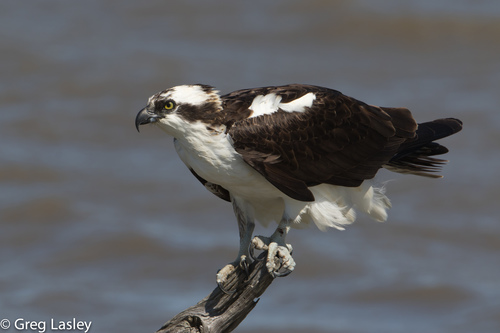
An osprey uses the longest days of early summer to hunt fish in the tidal waters near Manhattan, timing its dives to the aquatic insect emergence that concentrates prey in shallow channels.
The osprey is the only hawk that hunts by plunging into open water. Most raptors that take fish, like the great blue heron working the channel edge right now, wade or wait at the surface. The osprey drops from height and goes under, sometimes fully submerged, gripping fish with feet that are built for it: two toes forward, two back, and a rough pad surface that holds wet, slick prey. It shakes the water off before it even clears the surface, then repositions the fish headfirst in its feet for the flight back. That repositioning isn't incidental. A fish held sideways creates drag. The osprey corrects for it almost immediately. Watch one carry a fish any distance and you'll see it.
Early summer is the best time of year to watch this. The days are at their longest, which means more usable hunting hours, and the tidal shallows here warm quickly through June. That warming matters because of what it does to insects. Mayflies are emerging from the bottom sediments of these channels right now, in the hundreds and thousands. They have spent months underwater as nymphs, and they are coming up to molt, mate, and die within a day or two. That emergence draws fish to the surface in a way that almost nothing else does. Striped bass, white perch, and juvenile bluefish move into shallow water to feed on the insects, and they feed near the surface, where an osprey can reach them. The mayfly emergence is not something the osprey targets directly. It targets the fish that the mayflies concentrate. The insects are doing the work of aggregating the prey.
This kind of stacking, where one emergence event creates feeding conditions for something further up the chain, is common in tidal systems. The double-crested cormorant uses it too, diving from the surface into the same channels where fish are feeding. But the osprey and the cormorant aren't really competing for the same fish. The cormorant works subsurface and takes what it can run down underwater. The osprey needs fish close enough to the surface to be visible from above and catchable in a short dive. They are using the same channel at different depths.
The black-crowned night heron, which roosts nearby and feeds at the channel margins after dark, is working a different shift entirely. In early summer the nights are short, but the heron's low-light vision and patient stand-and-wait approach let it take fish that have moved into the shallows to feed on invertebrates after sunset. What looks like a single habitat, one stretch of tidal marsh, is actually being used in sequential layers through the day.
The osprey is still circling. It has adjusted its position twice, drifting downwind and then correcting back. Its head stays level while its body moves with the air. When it folds and drops, it will happen fast, and it will happen without warning. If you are watching the water below it rather than the bird itself, you will miss the moment entirely. The surface is flat and bright, and somewhere just under it, a fish is feeding.
