June 27, 2026
More details ↓
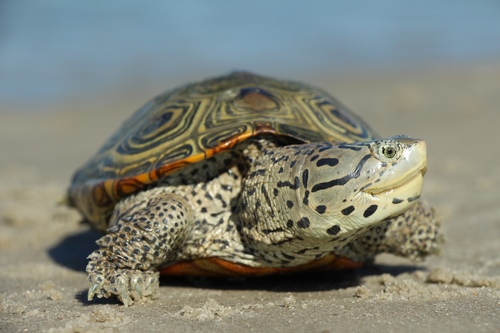
Female diamondback terrapins emerge from brackish water to nest in sandy substrate during the peak nesting window of early summer, a vulnerable crossing between aquatic and terrestrial worlds.
Along the brackish edges of the Hackensack Meadowlands, the tidal marsh grasses stand full and green in the longest days of the year. The water is warm. The mud at the marsh edge holds heat through the night. And on the sandy berms and upland margins that border these wetlands, female diamondback terrapins are emerging from the water to nest.
The diamondback terrapin is the only turtle in North America that lives exclusively in brackish water, the mix of salt and fresh that defines estuaries like this one. She spends most of her life in the tidal creeks and coves of the Meadowlands, eating periwinkles, fiddler crabs, and mussels, moving with the tides. But in early summer, something shifts. Females become restless and begin to move toward shore. They are looking for dry, sandy, well-drained ground, often above the high tide line, where soil temperatures are warm enough to incubate eggs. A female may travel several hundred meters from the water's edge. She crosses roads. She pushes through beach grass. She excavates a flask-shaped cavity with her back feet, deposits four to eighteen eggs, fills the nest in, and returns to the water. The whole process can take less than an hour.
What makes this moment ecologically significant is how exposed it is. In the water, a terrapin is difficult to catch. On land, she is slow, conspicuous, and committed. Common grackles and black-crowned night herons, both present along these wetland margins right now, are capable of taking hatchlings. Raccoons and foxes find and excavate nests with regularity, sometimes destroying a high percentage of eggs in a given area. Roads are the other pressure. The sandy, elevated ground terrapins prefer for nesting often sits on the far side of a road from the water, and females are struck by vehicles during the crossing. In places where terrapin populations have been studied along the northeastern coast, road mortality of nesting females has been one of the primary drivers of population decline, because females reproduce slowly. A female terrapin does not reach sexual maturity until she is seven to ten years old. She may live for more than twenty-five years. Each adult female lost to a car represents decades of potential reproduction removed from the population.
The eggs themselves incubate for roughly sixty to seventy-five days, depending on soil temperature. Warmer nests develop faster. The sex of the hatchlings is also determined by temperature during a critical window mid-incubation: warmer conditions produce more females, cooler conditions more males. Nests that receive full sun through late summer will skew female-heavy. This temperature-dependent sex determination means that the aspect and shade cover of a nesting site shapes the population's future composition. When hatchlings emerge in late summer, they are small enough to fit in a tablespoon. Many move toward the water immediately. Some overwinter in the nest and emerge the following spring.
The Hackensack Meadowlands hold one of the more significant terrapin populations remaining in the region. The estuary provides the right combination of brackish tidal habitat and upland nesting areas, though development has reduced and fragmented both. Terrapins here share their wetland margins with red-winged blackbirds singing from the phragmites tops, with great blue herons standing still in the shallows, and with ospreys working the open water above. All of these species are part of the same tidal system, drawing on the same productive estuary in different ways. The terrapin's role is particular: she moves nutrients and energy between the water column and the upland, and her eggs, whether they hatch or are predated, become part of the terrestrial food web above the tide line.
If you are near any of the tidal margins around Jersey City right now, look at the sandy edges, the gravel shoulders near marsh, the dry elevated ground above the water. A nesting female leaves a distinctive track, a wide drag mark with alternating flipper prints on either side. The morning light is still low enough to cast shadows across the ground. You might find one.
