June 26, 2026
More details ↓
As Indian plum ripens its first fruits in early June, Steller's jays arrive to feed—a threshold moment in the plant's reproductive cycle and the bird's nesting season.
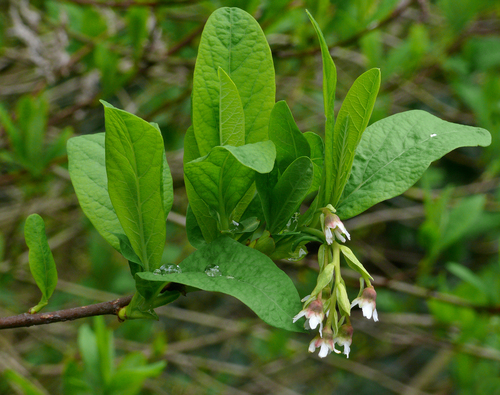
The understory along the trails at Sehome Hill Arboretum is dense and green right now, the bigleaf maples and vine maples filling in overhead so fully that the light comes through in patches. Down in the shrub layer, Indian plum has already made its move. While most shrubs are still in flower or just beginning to set fruit, Indian plum is ahead of all of them. The small, olive-colored fruits hang in loose clusters from branches that leafed out back in late winter, the earliest woody plant in the understory to do so. By early summer, those fruits are ripening to blue-black, and the Steller's jays know it.
Indian plum is a native shrub of the Pacific Coast understory, common in second-growth forests, woodland edges, and the kind of mixed shrubby habitat that runs through the arboretum here. It flowers in late winter, sometimes while snow is still possible, and fruits months before most other shrubs in the same community. Oceanspray, which is blooming right now with its creamy white flower clusters, won't fruit until late summer. Snowberry holds its white berries into fall. Indian plum doesn't wait. That early fruiting is the point: it makes itself available at a moment when almost nothing else does, and the jays are one of the animals that takes full advantage of it.
Steller's jays are corvids, closely related to crows and ravens, and they carry the intelligence of that family into everything they do with food. They don't just eat what's in front of them. They cache. A jay will take a fruit, sometimes swallow it whole, sometimes carry it to a branch and work it apart with its bill, and sometimes fly off with it to store it somewhere else entirely. In nesting season, which is happening right now, the behavior shifts slightly. Adults are feeding young, which means they need high-energy food reliably and often. Indian plum's fruits are small but calorie-dense, and the timing lines up with the period when jay pairs are making the most trips back to the nest. If you hear that sharp, scolding call somewhere in the canopy above you, and then a brief silence, and then the rustle of something moving through leaves, there's a reasonable chance a jay just landed in an Indian plum and is working through the cluster.
The relationship runs in both directions. Steller's jays are effective seed dispersers. A jay that swallows an Indian plum fruit whole and flies two hundred meters before digesting it has moved that seed somewhere the parent plant never could. The seeds that pass through a bird's gut often germinate more readily than those that fall directly beneath the parent shrub, partly because the pulp has been removed and partly because they land somewhere with less competition from the parent plant's own root system. Indian plum's early fruiting isn't just about being first to attract birds; it concentrates dispersal at a moment when jays are active, hungry, and moving constantly through the forest. The plant is not passive in this. It produces fruits with thin, easily digested flesh around a hard pit, a structure that rewards quick consumption and increases the chance the seed survives the trip.
Other birds use Indian plum too. Swainson's thrushes are moving through the arboretum right now, and they take fruit when they find it. Chestnut-backed chickadees will occasionally pick at the soft flesh. But Steller's jays are the most consistent and probably the most effective dispersers here, given their size, their range, and the distances they travel. The crows are present as well, and they'll take the fruit, but crows tend to work more open ground. The jays are the ones moving through exactly the kind of dense shrubby understory where Indian plum grows.
The oceanspray is in full flower along the sunny edges right now, white and fragrant, and that will be the next chapter. But look into the shadier parts of the understory, where the Indian plum branches hang low and the fruit clusters are visible if you stop and focus. The fruits are small, maybe the size of a blueberry, dark against the green leaves. Watch for a few seconds. The jays don't stay long in one place.
