June 25, 2026
More details ↓
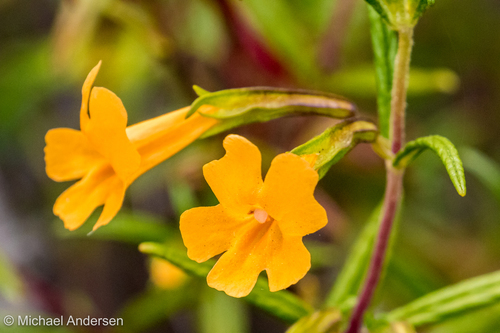
As orange bush monkeyflower opens its flowers in early summer, bumble bees arrive to pollinate while gathering nectar and pollen, a foundational relationship that sustains both species.
Along the scrubby slopes and dry edges of San Francisco's South of Market open spaces, the orange bush monkeyflower is in full flower. The blooms are trumpet-shaped, two-lipped, and a deep burnt orange that holds its color even in the flat midday light. Each flower opens wide enough to admit a bee, and that is precisely what it is built for.
The orange bush monkeyflower is a woody shrub native to California's coastal ranges and foothills, and it is well-suited to the dry, fog-cooled summers of this part of the city. It blooms through the longest days of the year, when soil moisture has dropped and most other plants have pulled back. The flowers are arranged so that a visiting bee, landing on the lower lip, is positioned directly beneath the anthers. Pollen falls onto the bee's back and thorax as it works its way toward the nectar at the base of the tube. The stigma, the part of the flower that receives pollen, is positioned near the entrance and is touch-sensitive: it closes within seconds of contact. This is a physical mechanism, not a slow process. When a bee brushes the stigma coming in, it closes. When the bee leaves and the stigma reopens, it is ready for pollen from the next visitor.
Bumble bees are the primary pollinators here. They are large enough to make full contact with both the anthers and the stigma in a single visit, and they are strong fliers in the cool marine air that moves through San Francisco in summer. They visit the monkeyflower repeatedly across a foraging bout, carrying pollen from plant to plant. The bumble bee is not simply collecting; it is working. It grips the lower lip, pushes into the tube, and vibrates its flight muscles against the anthers to shake loose pollen, a behavior called buzz pollination. The sound is audible: a higher, shorter burst than the bee's normal flight tone. If you are near a flowering shrub right now, listen for it. It is distinct from the steady hum of a bee in flight.
The monkeyflower offers both nectar and pollen to its visitors. Nectar fuels the bees directly. Pollen is gathered into the corbiculae, the pollen baskets on the bee's hind legs, and carried back to the colony to feed larvae. In return, the plant gets cross-pollination: pollen moved between individual plants, which increases genetic variation in the seed set. Neither species is doing the other a favor in any deliberate sense. The bee is feeding itself and its colony. The plant is structured to use that behavior. The relationship holds because both parties gain something from the same interaction.
Coyote brush grows nearby, its young leaves bright and sticky in the summer heat. California blackberry is leafing out along wetter margins. These plants will support other pollinators later in the season, but right now the monkeyflower is the primary flowering resource in this dry scrub community. Bumble bee colonies are at or near their peak size in early summer, with the most foragers in the field. The overlap between colony demand and monkeyflower bloom is not coincidental: the bees follow available forage, and the monkeyflower's bloom window corresponds to the period of highest bee activity. Seaside buckwheat and California fuchsia will carry the late-summer nectar supply forward as the monkeyflower finishes, giving bumble bee colonies resources through the season until new queens disperse in fall.
The scrub here sits within a dense urban area, and the patches where monkeyflower grows are small and discontinuous. Bumble bees range widely, sometimes more than a kilometer from the colony, so they can move between isolated patches. But the invasive fennel now established in parts of this area competes for the same dry disturbed ground the monkeyflower prefers, and poison hemlock has taken hold along some edges. Both are invasive species that reduce the area available for native flowering plants. The monkeyflower persists where it has space and sun.
Stand near one of the shrubs for a moment. The flowers are at about waist height on most plants, and the orange is warm against the gray-green of the foliage. A bumble bee moves between them, unhurried and deliberate, pausing at each flower long enough to work it. Listen for that brief, higher buzz when it presses into the tube.
