June 25, 2026
More details ↓
As mayflies, caddisflies, and other aquatic insects emerge en masse in early summer, Chimney Swifts—aerial insectivores nesting in the region—exploit this predictable food pulse to fuel their breeding season and feed growing nestlings.
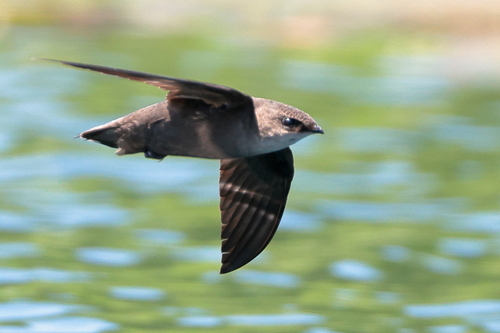
Look up. Over the open ground at SGL 198, chimney swifts are cutting arcs across the sky, chattering as they go. That high, thin chipping call is almost continuous when a group is working the air above a field or water. The birds themselves are small and dark, with a stiff, flickering wingbeat unlike any swallow — they look as though they are beating both wings alternately rather than together, though they are not. What they are doing up there, right now, is feeding. And what they are feeding on is the early summer emergence of aquatic insects.
Mayflies and caddisflies spend most of their lives underwater. Mayfly nymphs live in stream gravel and leaf litter for months, sometimes more than a year, grazing on algae and organic debris. Caddisfly larvae build cases from sand grains or plant fragments and do the same. Then, in early summer, they transform and leave the water. Mayflies emerge as winged adults that cannot feed at all — their mouthparts are vestigial, their digestive systems reduced. They have hours or days to find a mate and deposit eggs before they die. Caddisflies live a little longer as adults but are similarly driven by the narrow window of their emergence. Both emerge in large numbers over short periods, which concentrates them in the air above streams and ponds at predictable times. Chimney swifts find them there.
A swift forages entirely on the wing. It drinks on the wing, skimming a water surface. It collects nesting material on the wing, snapping dead twigs from treetops as it passes. During nesting season, the adults must catch enough insects not only to sustain themselves but to carry back to nestlings in whatever chimney or hollow tree they have claimed. Swifts compress multiple insects into a mass in their throat pouch before returning to the nest. A single feeding trip can deliver dozens of small insects at once. The aquatic emergence matters because it produces exactly what the birds need: large numbers of soft-bodied, protein-rich insects concentrated in open airspace over water, reliably, at the time of year when nestlings are growing fastest.
The swifts at SGL 198 are working the open fields and edges near the strip mine areas, which likely drain into small streams and wet areas. Those drainages, even modest ones, produce mayflies and caddisflies. The birds range widely from their nest sites — several kilometers is unremarkable — so a swift nesting in a chimney in Ashville may be foraging over water a mile or more away. Other aerial insectivores are doing the same thing. Eastern phoebes and eastern wood-pewees are both present here, taking insects in sallying flights from exposed perches at the forest edge. They are working a different layer of the same emergence, catching insects closer to vegetation rather than high in open air. The resource is large enough that the birds partition it by flight style and hunting height without much direct competition.
One thing worth knowing about chimney swifts is that their dependence on chimneys is relatively recent. Before European settlement, they nested in large hollow trees. As old-growth forest was cleared, they shifted to brick chimneys, which are now declining in number as buildings are renovated or demolished and new construction uses flue liners that swifts cannot grip. Populations have dropped significantly over the past several decades. The birds you see overhead are using whatever structures remain available within range, and the open foraging habitat at SGL 198 — with its fields, edges, and adjacent water — is part of what makes a landscape usable for them.
The chattering is easy to hear if the birds are still overhead. It carries well even at height. If you watch one bird long enough to track it through a full arc, you may catch the moment it closes on something — a slight check in the wingbeat, a fractional adjustment in the line of flight. Then it continues, already looking for the next one.
