June 26, 2026
More details ↓
As common milkweed blooms in early summer, red milkweed beetles emerge to feed on the flowers and leaves, a relationship visible at its seasonal peak in the longest days of June.
The common milkweed along the roadsides and field edges near Mechanicsburg is in full bloom right now. The flower clusters are tight pink-purple spheres, each one made up of dozens of small individual flowers with reflexed petals and a fused central crown. If you're near a patch, you can probably smell them from several feet away, a heavy sweetness that carries on still air. Look closely at those flower heads and you may find what's there most days at this point in early summer: red milkweed beetles, one or several, moving slowly across the blooms.
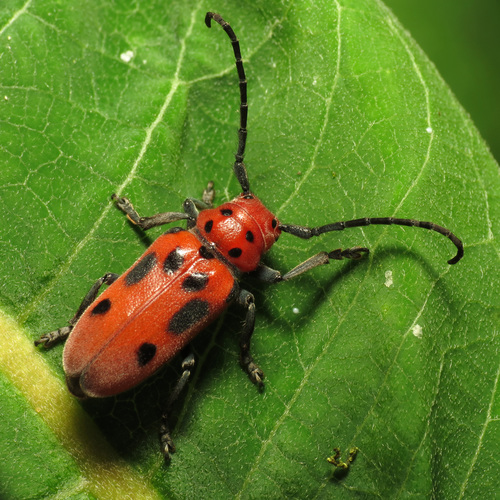
The red milkweed beetle is a longhorned beetle, stocky and about three-quarters of an inch long, with bright red wing covers marked by four black spots. Its antennae are nearly as long as its body, banded in black and red, and it holds them angled forward as it walks. This beetle does not visit milkweed the way a generalist insect might, stopping by for a meal before moving on. It is specifically and deeply tied to milkweed. The larvae hatch from eggs laid in the soil near milkweed roots and spend their first year underground, chewing into the root tissue. The adults that emerge in early summer return immediately to the plant, feeding on the flowers, leaves, and stems. The whole life cycle runs on a single genus. When milkweed is present, the beetle is usually present. When milkweed is absent, the beetle is not.
Milkweed produces latex, a sticky white sap that runs through the leaves and stems under pressure. For most insects, this latex is a serious problem. It gums up mouthparts, hardens quickly on contact, and contains toxic compounds called cardiac glycosides that interfere with the nervous systems of vertebrates. The red milkweed beetle manages this by cutting into the leaf's midrib or a stem vein before it feeds, releasing the latex pressure upstream of where it will eat. The latex bleeds out, the pressure drops, and the beetle feeds on tissue that is no longer flooded with sap. This is not a general insect trick. It is a specific behavior, and it is one reason this beetle can live on a plant that many others cannot. The cardiac glycosides the beetle does ingest accumulate in its body and make it unpalatable to most predators. The red and black coloration is a signal that birds and other predators learn to associate with a bad experience. It is the same warning system used by monarch butterflies, which feed on the same plant for the same reason.
The milkweed patch itself is a dense community this time of year. Western honey bees, which are invasive here, work the flowers heavily alongside native bumblebees and smaller native bees, all drawn by the nectar. Milkweed flowers have a specific structure: pollen is packaged in small clip-like masses called pollinia, which attach to the legs of visiting insects and are transferred to the next flower. It is an exacting mechanism, and insects sometimes become temporarily trapped in the flower's grooves while the pollinia attach. Larger insects pull free; smaller ones sometimes do not. The red milkweed beetle, which feeds on the flowers rather than gathering nectar efficiently, moves pollen incidentally as it walks. It is not the plant's primary pollinator, but it is present at every flower it eats.
Look at the broader edge habitat here. Black cherry is fruiting in the canopy above these fields, and Carolina wrens are singing from the shrub layer, loud and repetitive, the same phrase turned over and over. The milkweed patch sits in the same weedy corridor where purple crownvetch, an invasive species, has spread along the margins. That competition matters for milkweed abundance over time, but right now the blooming plants are holding their ground. The beetles are on them. If you stand still near a flower head for a minute, you can watch one move, antennae working, feet gripping the small flowers, the red of its body vivid against the pink of the bloom.
