June 24, 2026
More details ↓
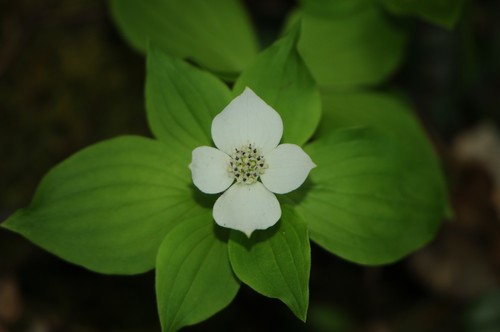
As bunchberry dogwood enters peak bloom in early June, its small but abundant flowers become a concentrated food source for insects during the height of nesting season when parent birds need protein most.
In the shaded understory of Bainbridge Island's second-growth forest, the ground is white right now. Not snow, not frost, but bunchberry dogwood in full bloom, its flowers open across the forest floor in dense, low mats that catch whatever light filters through the vine maple and redosier dogwood overhead. The blooms are small, a cluster of tiny true flowers surrounded by four white bracts that do the visual work of attracting visitors. Individually they are modest. Collectively, spread across meters of damp ground, they are a significant food source at a moment when the forest needs one.
Bunchberry dogwood is a ground-level plant, rarely more than twenty centimeters tall, and it spreads by rhizome into loose colonies across moist, shaded forest floor. What it lacks in height it makes up in density. Each cluster of white bracts frames a tight center of small flowers, and those flowers produce nectar and pollen over a bloom period that coincides almost exactly with the longest days of early summer. The timing matters. This is when aquatic insects are emerging from nearby streams and wetlands, when the forest canopy is thick with flying invertebrates, and when every nesting bird on the island is making repeated foraging trips to feed protein to nestlings. The bunchberry adds to that supply. Not dramatically, but consistently, and at the right moment.
The flowers attract small bees, flies, beetles, and wasps, including the invasive European paper wasp, which forages widely across the understory this time of year. These visitors collect pollen and nectar, and in doing so transfer pollen between plants. The pollination mechanism in bunchberry is worth knowing: the flowers are spring-loaded. When a visiting insect contacts the stamens, the anthers release pollen explosively, coating the visitor in under half a millisecond. It is one of the fastest movements in the plant world. The insect moves on, dusted with pollen, and the plant's reproduction moves with it. Look closely at the center of an open flower cluster and you may see the spent anthers, already triggered, curled outward.
What the insects carry away, the birds collect indirectly. Chestnut-backed chickadees are nesting now, and they forage heavily on the small insects that gather at flowering plants like this one. Spotted towhees work the leaf litter nearby, turning over debris in search of invertebrates. Bewick's wrens move through shrubby tangles at the forest edge, taking flies and small beetles. These birds are not visiting the bunchberry directly; they are harvesting the insects that the flowers have concentrated. The plant functions as a gathering point, and the gathering feeds the next layer up. Later in the season, bunchberry will produce tight clusters of bright red fruit, and those same birds will return for a different reason entirely. Right now, though, it is the flowers doing the work.
The forest floor here holds other plants in bloom or coming into bloom. Common snowberry is opening its small pink flowers along the edges of the understory, and ocean spray is building toward its own peak further out in the drier, more open areas. But bunchberry is the one flowering at ground level, in the shade, where the soil stays cool and damp. That niche is specific. The insects that work low and slow through shaded forest find it reliably. If you are standing near a patch right now, crouch down and watch the flower clusters for thirty seconds. The visitors are small and quick, but they are there.
