June 27, 2026
More details ↓
Gulf fritillary butterflies are actively laying eggs on passion vine plants in summer, a critical moment in their reproductive cycle when caterpillars will feed and develop through the warm season.
The air near Faubourg St. John sits heavy and still in summer, the kind of heat that flattens everything into shade. Along fences, chain-link and wooden both, and scrambling up into the lower branches of live oaks, passion vine grows in dense curtains of lobed leaves. Watch the open sunny edges of that vine. A Gulf fritillary will find it.
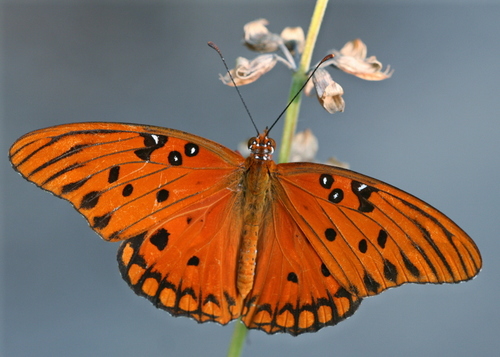
The Gulf fritillary is a medium-sized butterfly, bright orange on the upper wings with black margins and white spots, silver-spangled underneath. It moves through the neighborhood in a loose, unhurried glide, but when a female locates passion vine, her behavior changes. She lands briefly, drums her forelegs against a leaf surface, and moves on, then returns, then lands again. She is tasting the plant through chemoreceptors in her feet, confirming the chemistry before she commits. When she is satisfied, she curves her abdomen and places a single pale yellow egg on a tendril, a leaf edge, or a stem. One egg, then she moves to another part of the vine. She rarely clusters them. The caterpillars that hatch are aggressive feeders, and spacing the eggs reduces competition between siblings on the same plant.
Passion vine is the only plant Gulf fritillary caterpillars can eat. The relationship is specific and non-negotiable. The vine produces compounds called cyanogenic glycosides, which are toxic to most insects, but Gulf fritillary caterpillars not only tolerate them, they sequester the compounds in their own tissues, making themselves unpalatable to birds. The caterpillars are vivid orange and black, advertising this fact. A bird that tries one learns quickly. The adult butterflies carry some of that chemical protection too, absorbed during their time as caterpillars. The passion vine, for its part, has not been entirely passive in this arrangement. Some species produce extrafloral nectaries, small glands on the leaves and stems that secrete sugar, which attract ants. Ants patrolling for that sugar will attack caterpillars and other herbivores. Whether the vine benefits more from that ant activity than it loses to the fritillary caterpillars is a question without a clean answer. Both are happening at once.
Summer is the peak of Gulf fritillary activity in New Orleans. Multiple generations cycle through between spring and the first cool weather of autumn. A caterpillar hatches, feeds for two to three weeks, pupates in a chrysalis that looks remarkably like a dried brown leaf, and emerges as an adult in roughly ten days. The adults nectar broadly, visiting lantana, ironweed, and whatever else is flowering in the heat, but reproduction always comes back to the passion vine. Females will fly considerable distances to find it, and in urban neighborhoods like this one, a single well-established vine on a fence can anchor a local population. The vine spreads aggressively in the Gulf Coast climate, which works in the fritillary's favor. Where the vine goes, the butterfly follows.
Other species move through this same patch of vine. Brown anoles, an invasive species established throughout the urban New Orleans landscape, hunt from the leaf surfaces and stems. They eat small insects, and caterpillars small enough are fair targets, though the fritillary's chemical defenses offer some protection as the caterpillar grows. Spinybacked orbweavers string webs across the vine's gaps, waiting for anything that flies through. Green anoles hunt from higher up. The vine is a structure as much as a plant, a physical scaffold that organizes a small community of predators, prey, and visitors.
If you are near any fence line or garden edge with dense vining growth, look at the leaf undersides and the tendrils. The eggs are small, ribbed, and pale yellow, easy to miss. The caterpillars are harder to miss once they are a week old, orange with black spines, moving steadily along a stem. And somewhere above the vine, if the sun is out, a fritillary is probably circling.
