June 25, 2026
More details ↓
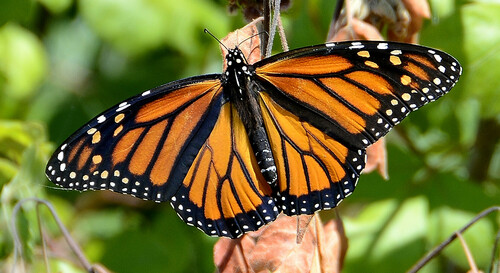
Female Monarchs are arriving during early summer to lay eggs on butterfly milkweed, the sole host plant for their caterpillars, as the plant flowers in the Milwaukee area.
Butterfly milkweed is blooming in the Milwaukee area right now, its flat-topped clusters of small orange flowers open in the sun. The plant grows low, rarely more than a foot or two tall, in dry and well-drained spots: roadsides, prairie remnants, open patches where the soil is thin. If you are near one of those places, look for a butterfly that is larger than it first appears, orange and black with white-edged wings, moving deliberately from plant to plant. That is a female monarch, and she is not here for the flowers.
Monarchs will drink nectar from many plants, but they can only reproduce on milkweeds. Butterfly milkweed is one of the species they use, and in this region it flowers in early summer, which is when the first females are arriving from the south. A female lands on a milkweed stem, walks it slowly, pressing the underside of a leaf with her forelegs. She is tasting it. Her feet carry chemoreceptors that can detect the compounds in milkweed tissue, and she is confirming that the plant is the right species before she commits. If it is, she curves her abdomen beneath the leaf and deposits a single egg, pale green and ribbed, about the size of a pinhead. Then she moves to the next plant, the next leaf. She will lay hundreds of eggs over the course of her adult life, almost never more than one per plant, spreading the risk across the landscape.
The egg hatches in three to five days. The caterpillar that emerges eats milkweed and nothing else. Butterfly milkweed, like all milkweeds, produces latex, a sticky white sap loaded with cardenolides, which are compounds toxic to most insects and vertebrates. Monarch caterpillars are not affected by them. They feed on the leaves, accumulate the cardenolides in their own tissue, and carry that chemical defense through metamorphosis into adulthood. A bird that eats a monarch gets sick. Most birds that have had that experience avoid the orange and black pattern afterward. The defense depends entirely on access to milkweed during the larval stage, which is why the female's host-finding behavior matters as much as it does. No milkweed, no caterpillars.
Butterfly milkweed is a native plant that has become less common across the Midwest as grasslands and open habitats have been reduced or taken over by invasive species. Dame's rocket, an invasive that is blooming in purple and white drifts along roadsides and disturbed edges throughout this area right now, occupies some of the same disturbed ground where butterfly milkweed might otherwise establish. The competition is not direct, but the pattern is familiar: native plants that need open soil and full sun lose ground when that habitat fills in, whether with invasives or with woody vegetation. Butterfly milkweed persists where it has been planted in gardens, in restored prairie patches, and in the drier margins of parks. Monarchs find it in all of those places.
The relationship between monarchs and milkweed is often described as simple, but the timing makes it complicated. Monarchs that overwintered in Mexico began moving north in spring, breeding as they went. The females arriving here now are likely the daughters or granddaughters of those overwintering adults, raised on milkweed further south and then continuing the northward movement. They need milkweed to be available when they arrive, which means the plant's flowering schedule and the insects' migration schedule have to align. In a year with a warm early spring, milkweed may flower earlier than usual. In a cool year, it may lag. The monarchs adjust somewhat, but the window is not unlimited.
Somewhere nearby, if the light is good and the air is warm, a monarch may be working the edges of a sunny patch right now, pausing on each milkweed plant just long enough to check it before moving on. The orange of the butterfly and the orange of the milkweed flowers are close enough in color that the two can be hard to separate at a distance. Watch for movement: the slight, deliberate shift from stem to stem that distinguishes an egg-laying female from a butterfly simply feeding.
