June 26, 2026
More details ↓
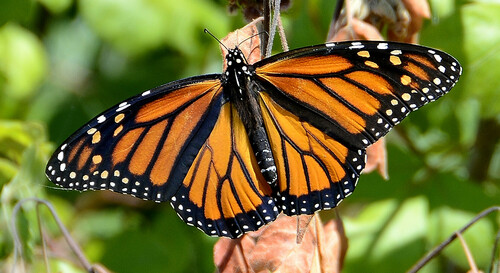
Female monarchs finding common milkweed plants at peak leaf stage to lay their eggs, beginning the breeding cycle that will define the summer generation.
The common milkweed plants along the edges of Chicago's green spaces are at their best right now. The leaves are broad and flat, dark green, still soft enough to bend without snapping. This is what a female monarch is looking for when she moves low over a patch of vegetation in early summer, and if you watch one long enough, you can see exactly how she decides.
She lands on a leaf and drums it with her front feet. This is not random movement. Her feet carry chemical receptors that detect the milkweed's latex compounds through contact, confirming the plant before she commits. She may check several leaves on the same plant, or leave and try another patch entirely. When she finds what she wants, she curves her abdomen under the leaf and deposits a single egg, pale green and ribbed, smaller than a sesame seed, on the underside. Then she moves on. A single female may lay several hundred eggs over the course of her adult life, but she places them one at a time, spread across as many plants as she can find. This distributes the risk. A caterpillar that strips one plant does not compete with its siblings on the next.
The milkweed's role here is not passive. The same latex that the monarch detects through her feet is a sticky, bitter sap that fills channels running through the leaves and stems. Most insects avoid it. A young monarch caterpillar, when it hatches, deals with this by cutting a circle into the leaf surface before eating, draining the latex from that section so it can feed safely. Older caterpillars learn to sever the leaf's midrib at the base, blocking the flow to the whole leaf. The plant is not helpless, but the monarch has worked out how to eat it anyway, and the cardenolides in the latex accumulate in the caterpillar's tissues as it feeds, making the caterpillar itself unpalatable to most birds. The monarch does not merely tolerate the milkweed's chemistry; it borrows it.
The red milkweed beetle is doing something similar in these same patches right now. It chews a trench around the midrib before feeding, stopping the latex flow the same way the caterpillar does. Both insects have arrived at the same mechanical solution independently, and both carry the plant's toxins in their bodies. The beetle's red and black coloring advertises this to predators just as the monarch's orange and black does. Neither insect is the other's competitor in any serious sense; milkweed patches in early summer can support both, along with the various bees and wasps that come for the flowers, which are just beginning to open on some plants now, the pink-purple clusters heavy and fragrant above the broad leaves.
For the monarchs in this area, the early summer generation is the one that matters most for local reproduction. The butterflies that arrived here in late spring came from overwintering sites in central Mexico, and they have already moved north ahead of the milkweed's emergence. Their offspring, the eggs being laid right now, will be the ones that hatch, feed, pupate, and emerge as adults here in Chicago. Those adults will produce another generation before the season turns. It is the last generation of the summer, not these, that will make the long flight south in autumn. The eggs on these milkweed leaves are the beginning of that chain.
Common milkweed grows in disturbed ground, roadsides, vacant lots, and park margins, the kind of habitat that exists in fragments throughout the city. The patches near the Loop are small by rural standards, but monarchs find them. Look for the plants where mown grass gives way to rougher growth, the leaves big and paired, the stem thick. If you find a patch, check the undersides of the leaves. The eggs are easy to miss, but they are there.
