June 26, 2026
More details ↓
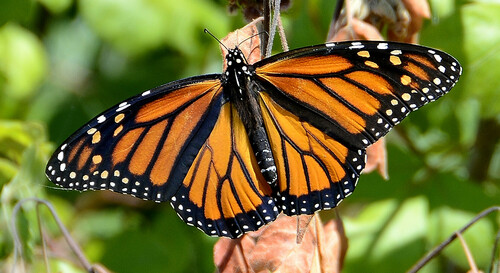
As monarchs pass through the Ann Arbor region during their breeding season, they locate and lay eggs on milkweed plants that are leafing out and growing rapidly.
Along the roadsides and field edges near Ann Arbor, common milkweed is pushing up fast. The stems are thick and pale green, the leaves broad and soft, still growing toward their full summer size. This is the plant monarchs are looking for right now, and a few of them have made it here.
Monarchs arriving in the Ann Arbor region in early summer are the first generation born after the overwintering population left Mexico in spring. They followed the milkweed north, breeding as they went, and their offspring are the ones moving through here now. A monarch searching for a place to lay eggs is not wandering. She flies low over vegetation, dropping toward plants, hovering briefly, then moving on. When she lands on a milkweed leaf, she presses the underside of her front feet against the surface. Monarchs have chemoreceptors in their tarsi, sensory structures that detect the chemical signature of milkweed on contact. If the plant is right, she curves her abdomen under the leaf and attaches a single egg, pale green and ridged, small enough to sit on a fingernail. Then she moves to the next plant.
She rarely lays more than one egg per plant. This is not accidental. Monarch caterpillars are solitary feeders, and a single milkweed stem does not have enough leaf mass to support more than one caterpillar through all five of its growth stages. Spreading eggs across multiple plants reduces competition and increases the chance that each larva survives to pupate. The eggs hatch in three to five days. The caterpillar that emerges eats its own eggshell first, then begins working through the leaf. It feeds on nothing else. Common milkweed produces cardenolides, compounds toxic to most insects and vertebrates, but monarch caterpillars have a modified version of the cellular protein that cardenolides normally disrupt. They can consume the toxin without harm, and the cardenolides accumulate in their bodies. Birds that have eaten a monarch and experienced the resulting nausea tend to avoid them afterward. The bold orange and black patterning of the adult makes that association easier to remember.
Common milkweed is doing well here in early summer because it is well suited to disturbed edges, roadsides, and old fields, the same habitats that have expanded as agricultural and suburban land use has changed the region. The plant spreads by rhizome, forming colonies that return reliably each year. Monarchs can find those colonies across large distances, though how they do this at the scale of a landscape is not fully understood. They respond to visual cues and plant chemistry, but a butterfly covering miles of mixed terrain, locating scattered milkweed patches, is doing something that researchers are still working to characterize precisely. What is clear is that the match between monarch arrival timing and milkweed leaf-out is close. Early summer milkweed leaves are young and high in water content, which benefits the caterpillars. As the season advances and the leaves toughen, they become less suitable. The timing works because both the insect and the plant are responding to the same seasonal cues: temperature and day length.
If you are near a field edge or a patch of open ground, look for milkweed. The stems stand upright, often in clusters, with opposite leaves and a distinctive oval shape. If monarchs are moving through, a female may be working the patch right now, low and methodical, pausing at each plant. The leaves in the sun smell faintly bitter if you brush them. That bitterness is the cardenolide, the same compound the caterpillar is built to handle and that makes the adult butterfly something most birds learn to leave alone.
