June 24, 2026
More details ↓
Fire salamanders emerge into early summer nights to hunt the small invertebrates sheltering in damp wood and leaf litter, a critical feeding window as they prepare for breeding season.
The oldest trees near Pentagone hold moisture long after the sun goes down. Bark loosens from decaying trunks, leaf litter mats into layers along the roots, and the soil beneath stays cool even on the longest days of early summer. This is the habitat a fire salamander needs: not water exactly, but the dampness that collects where wood rots and invertebrates shelter. After dark, when the temperature drops and humidity rises, these animals move through it slowly and deliberately, working the ground with their tongues.
Fire salamanders are not fast hunters. They are patient ones. A salamander will press itself close to a rotting log, tongue flicking to detect chemical traces left by earthworms, slugs, woodlice, and beetle larvae buried in the soft wood. The tongue strike itself is quick, but the approach is not. They cover ground methodically, quartering damp patches the way a dog works a scent trail, returning to productive spots on successive nights. Early summer is a critical feeding window for them. Females in particular are building reserves, because fire salamanders give birth to live larvae, small aquatic young that they carry internally until the larvae are ready to be deposited in a stream or seep. That investment is metabolically expensive, and the richness of summer invertebrate life in the leaf litter is what makes it possible.
The spotted longhorn beetle connects to this indirectly, and the connection runs through the same rotting wood. Spotted longhorn beetles are flower visitors as adults, conspicuous in early summer on hogweed and bramble, but their larvae develop inside dead and dying hardwood, feeding on the decaying tissue for one to three years before emerging. The frass and soft galleries they leave behind create exactly the loose, moisture-retaining substrate that concentrates the smaller invertebrates a fire salamander hunts. A beetle larva in its gallery is also, occasionally, prey itself. Salamanders are not selective in the way a specialist predator is. If something soft-bodied and slow is present in the wood, and the salamander encounters it, it will eat it. The beetle's larval stage and the salamander's hunting range overlap in the same decomposing wood, and what the beetle larva modifies in the wood, the salamander's other prey then colonizes.
The fire salamander is a threatened species here. Its presence near Pentagone depends on two things that urban green spaces often lack: standing deadwood left in place, and a water source close enough for larvae to be deposited. The European stag beetle, also recorded in this area and also threatened, shares the dependence on deadwood. Both species are indicators of something the site is doing right, that some of the old wood is being left to decay rather than cleared. The Asian lady beetle, an invasive species now abundant here, competes with native invertebrates for aphid prey and disrupts the food web at the smaller end, but its effect on the specific community of woodlice, worms, and beetle larvae that salamanders rely on is less direct.
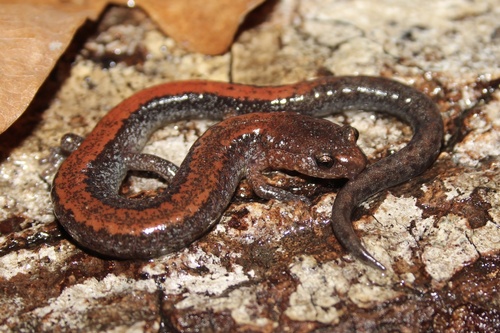
On a warm night in early summer, a salamander moving through the litter near a damp log is visible if you look slowly. The yellow and black patterning is not camouflage. It is a warning, advertising the toxic skin secretions the animal produces. Predators that have encountered one before avoid them. The pattern works because it is memorable, and it is memorable because it is so distinct: broad irregular patches of yellow against black, varying between individuals, consistent enough as a signal to be recognized. If you are out after dark near any of the older, damper tree stands at Pentagone, you might crouch beside a mossy log and wait. The salamander will come to you before you find it. Right now the ground is cool and damp beneath the canopy, and somewhere in that darkness a tongue is already working.
